



50 Quai Rambaud – Lyon, France
Le Sucre is one of the key institutions of contemporary electronic music in Lyon. Located on the rooftop of La Sucrière, a monumental former industrial building on the banks of the Saône, the club combines electronic music, concerts and cultural programming with one of the most distinctive locations in French nightlife.
The club opened permanently in 2013, but its origins are closely connected with Nuits Sonores, Lyon’s major electronic music festival. The association behind the festival, Arty Farty, wanted to translate the temporary energy of Nuits Sonores into a permanent venue operating throughout the year. La Sucrière was a natural choice: Nuits Sonores had already organised an event there during its first edition in 2003, when the surrounding district was still considerably more industrial than it is today.
From Industrial Port to Rooftop Club
La Sucrière was built as part of Lyon’s industrial port infrastructure and for decades was used for the storage and processing of sugar. Its enormous concrete volumes remain one of the architectural landmarks of Confluence, a former industrial and logistics district at the meeting point of the Rhône and Saône that has undergone extensive redevelopment since the beginning of the twenty-first century.
The first version of Le Sucre appeared temporarily on the building’s rooftop during the 2011 Lyon Biennale of Contemporary Art. The experiment proved successful enough for the space to be redeveloped permanently. On 26 June 2013, Le Sucre officially opened in its current form.
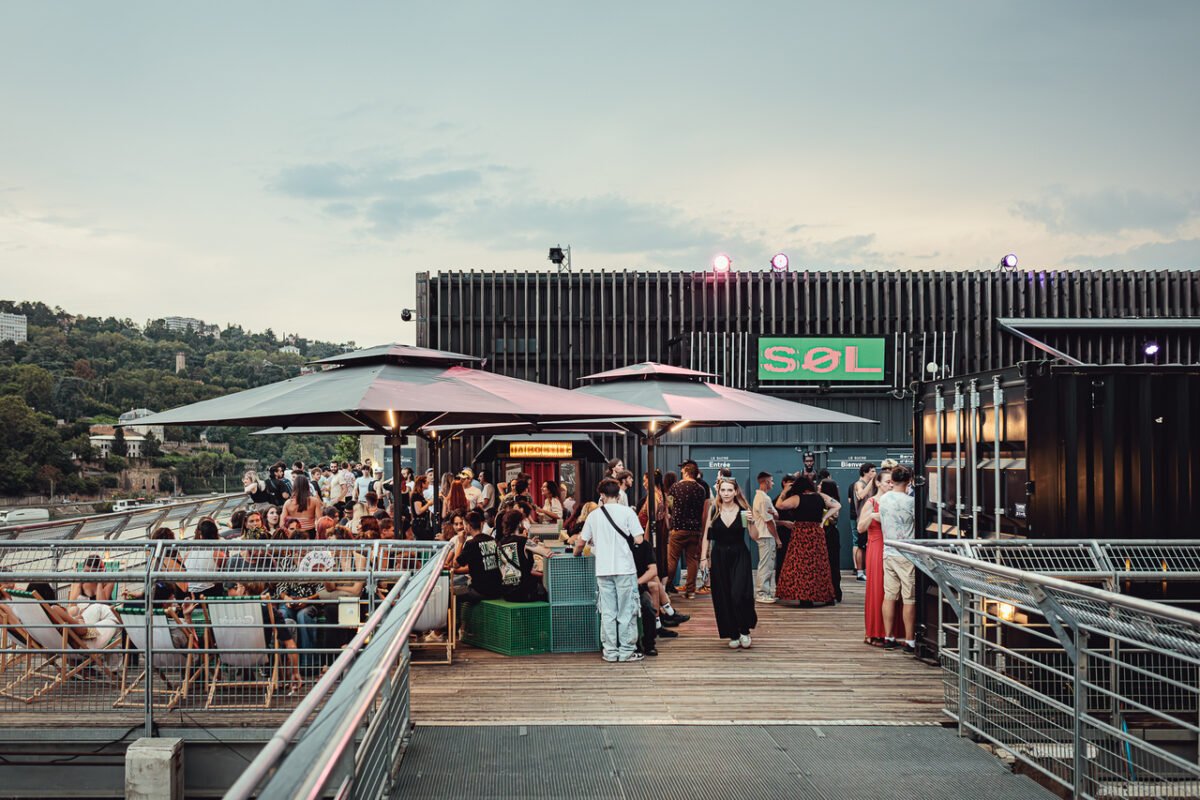
Transforming a rooftop sixteen metres above ground into a permanent nightclub presented considerable technical challenges, particularly around access, safety, acoustics and sound isolation. The resulting venue combines an indoor club with a large panoramic terrace, allowing the character of the space to change significantly between seasons and between daytime and nighttime programming.
One particularly important element was the sound system. Le Sucre installed a Meyer Sound system, with Laurent Garnier personally involved in selecting and calibrating the equipment. Garnier had already been closely associated with Nuits Sonores since its early editions and later returned to Le Sucre for numerous performances, including more unusual sets outside his conventional techno repertoire.
The Nuits Sonores Connection
Le Sucre is difficult to understand independently from Nuits Sonores. Rather than creating a conventional nightclub and then occasionally hosting festival events, Arty Farty approached the project almost in reverse: Le Sucre was conceived as a permanent extension of festival culture.
This philosophy influenced everything from programming to the relationship between artists and audience. The club deliberately rejected some conventions historically associated with French nightlife, including VIP tables, restrictive dress codes and an excessive separation between performers and dancers. Tickets are generally purchased in advance, encouraging visitors to choose a night because of its programme rather than simply arriving at the venue as part of a generic night out.
Musically, this means Le Sucre has never been exclusively a techno club. House, techno, electro, acid, bass, jungle, disco and experimental electronic music coexist with jazz, hip-hop, live performances and more difficult-to-classify projects. Established international artists regularly appear alongside emerging French and Lyon-based DJs.
The relationship with Nuits Sonores works in both directions. Artists discovered through the festival can later become part of the club’s programme, while local artists developed through Le Sucre can progress towards larger festival stages. Residencies and collaborations with local collectives make the venue function partly as a laboratory for the wider Lyon electronic scene.
A Club Above the City
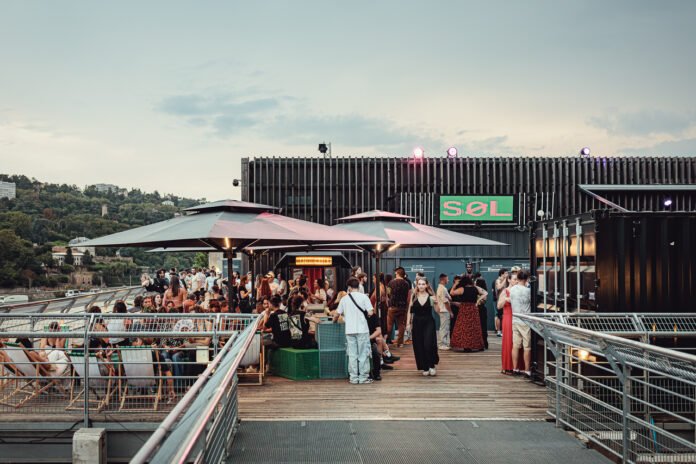
The physical character of Le Sucre separates it from many European electronic music institutions. The main club room is relatively compact, while the terrace opens directly towards the surrounding city. This creates two very different environments within the same venue: an enclosed dancefloor built around sound and lighting, and an outdoor rooftop where the industrial landscape of Confluence becomes part of the experience.
The club currently accommodates around 780 people, making it large enough for major international bookings while remaining considerably more intimate than an arena or festival stage. It operates throughout the year and hosts more than two hundred events annually.
Over time, recurring formats such as S.society have become part of its identity, while collaborations with outside collectives continuously change the musical direction. The club also regularly redesigns its scenography rather than treating the interior as a finished architectural object.
This willingness to experiment extends beyond music. Le Sucre has hosted performances, installations, talks, unusual live projects and artist residencies, reflecting the broader cultural philosophy inherited from Arty Farty. Its role is therefore closer to a cultural club than a conventional discothèque.
Lyon’s Electronic Ecosystem
Le Sucre also illustrates why Lyon has developed one of France’s strongest electronic music scenes outside Paris. Nuits Sonores created an international platform, but permanent infrastructure was necessary to maintain a community throughout the rest of the year.
Le Sucre provided that continuity. Instead of electronic culture appearing in Lyon for several days each May and then disappearing, artists, promoters and audiences gained a permanent meeting point connected directly with the festival’s network.
The club has subsequently helped develop local artists and residents while maintaining connections with the wider European circuit. Its programming has included figures from several generations of electronic music, while deliberately avoiding a narrow definition of what contemporary club music should sound like.
That openness remains central to its identity. A weekend can move from Detroit techno or experimental bass music to house, disco or a queer collective without the venue appearing to fundamentally change direction. The consistency comes from curation rather than genre.
Present
More than a decade after opening, Le Sucre remains active at 50 Quai Rambaud, with a capacity of around 780 and a programme running throughout the year. The wider Confluence district surrounding it has changed dramatically: former industrial land has become one of Lyon’s major redevelopment zones, filled with contemporary architecture, offices, apartments and cultural institutions.
La Sucrière and Le Sucre preserve an important layer of what existed before that transformation. The industrial building remains, but instead of functioning as abandoned heritage it has acquired a new cultural purpose.
Within French club culture, Le Sucre therefore occupies an unusual position. It is neither an underground warehouse operating temporarily on the margins of legality nor a conventional commercial nightclub. It emerged from a festival, occupies a transformed industrial landmark and functions simultaneously as a club, cultural venue and platform for the local scene.
The concept can be reduced to something surprisingly simple: Nuits Sonores needed a home for the other 360 days of the year. Le Sucre became that home.
