



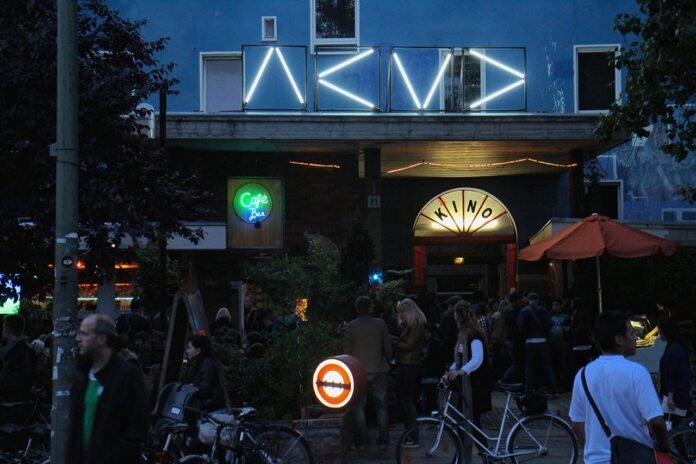
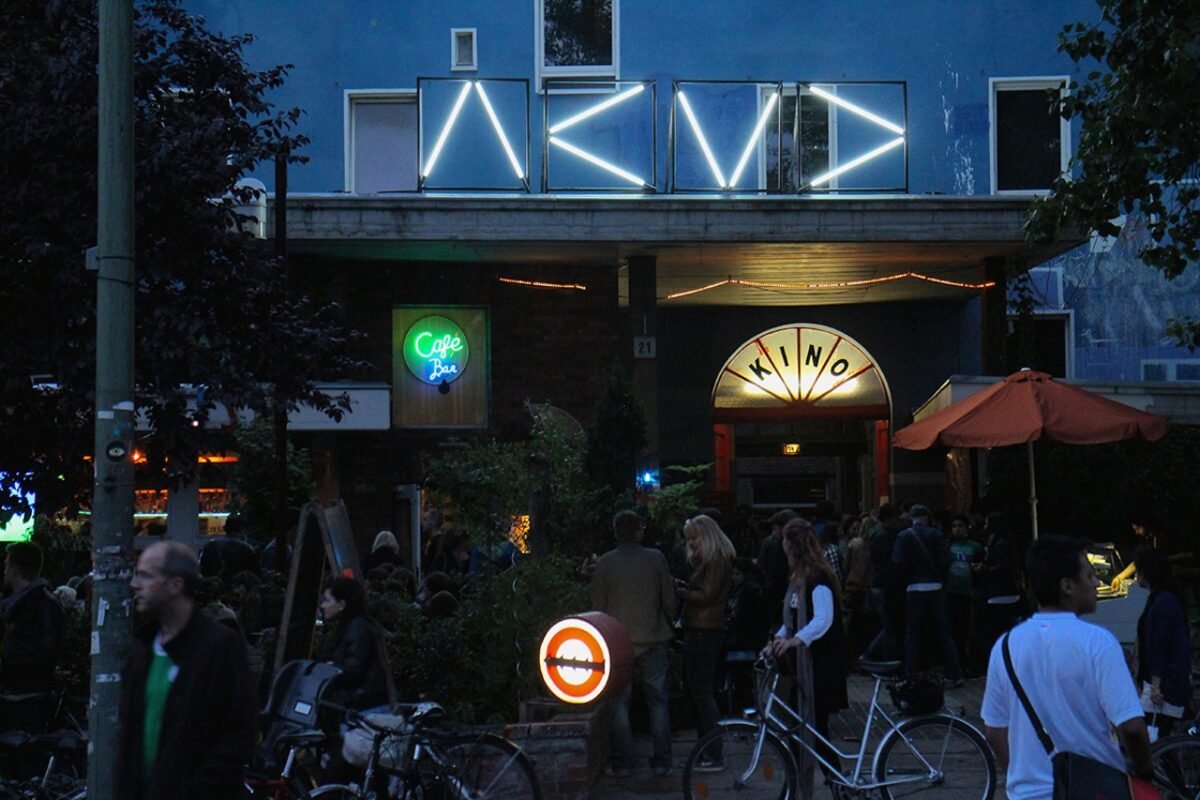
Veteranenstraße 21 – Berlin, Germany
ACUD is one of Berlin’s longest-running independent cultural spaces. Located at Veteranenstraße 21 in Mitte, close to Rosenthaler Platz, it combines a small club with galleries, theatre, cinema, studios and spaces for performances and workshops. Rather than operating as a conventional nightclub, ACUD exists somewhere between an arts centre, experimental music venue and underground clubhouse.
Its importance lies partly in its history. Kunsthaus ACUD was founded in 1991 by artists from East Berlin, at a moment when reunification had opened enormous physical and cultural spaces across the centre of the city. Empty buildings, uncertain ownership and low rents allowed artists, musicians and independent organisations to establish venues with relatively little commercial pressure. ACUD emerged directly from this environment and, unusually, survived as the neighbourhood around it changed almost beyond recognition.
From Post-Wall Berlin to Mitte
The Berlin surrounding ACUD in the early 1990s was radically different from today’s Mitte. Large parts of the former East Berlin centre contained abandoned buildings and inexpensive spaces, while artists from both sides of the former border experimented with new forms of cultural organisation. Clubs, galleries, squats and temporary venues appeared throughout Mitte and Prenzlauer Berg.
Over the following decades, many of these spaces disappeared as property values increased and central Berlin became progressively more commercial. ACUD remained at Veteranenstraße, maintaining its original idea of providing space for artistic experimentation outside purely commercial structures.
This continuity makes the venue particularly interesting. ACUD is not a recreation of Berlin’s post-Wall underground culture; it is one of the institutions that actually emerged from it.
ACUD Club
The club is a relatively small part of the wider Kunsthaus, with space for roughly 160 people. Its scale creates an atmosphere fundamentally different from Berlin’s warehouse venues. There is no monumental turbine hall or enormous industrial dancefloor. Artists and audience occupy essentially the same compact environment, making the room suitable for performances that depend on concentration and proximity as much as physical intensity.
Programming reflects this scale. Electronic music is important, but ACUD has never restricted itself to techno or house. Experimental electronics, bass, dub, sound art, live performances and unconventional DJ sets regularly coexist with concerts, installations, readings and interdisciplinary events.
Over the years, the programme has included artists such as Ziúr, Phase Fatale, Drew McDowall, Hainbach and Awesome Tapes From Africa alongside emerging Berlin artists and international experimental musicians. Individual nights can move from techno into noise, ambient, bass or forms of electronic music that would be difficult to place within the programming model of a conventional nightclub.
The venue also works closely with independent curators, collectives and cultural organisations. As a result, the identity of ACUD is defined less by one musical genre than by an interest in experimentation and communities operating outside mainstream cultural structures.
Art, Community and Club Culture
The distinction between ACUD and a conventional club becomes particularly clear when looking at the building as a whole. A visitor might come to Veteranenstraße for an exhibition, theatre performance, film screening or workshop rather than a club night. The different activities share the same cultural infrastructure and frequently overlap.
This interdisciplinary model reflects an older understanding of Berlin underground culture in which electronic music, visual art, performance and political activity were rarely completely separate scenes. ACUD continues that approach at a time when much of the city’s nightlife has become increasingly professionalised and internationally recognised.
The organisation explicitly positions itself as a space for artistic freedom and underrepresented communities, with programming involving queer, migrant, BIPOC and FLINTA artists and initiatives. Club events are consequently treated not simply as entertainment but as part of a broader cultural and social programme.
Present
In 2026, ACUD celebrated its 35th anniversary while continuing to operate from the same address on Veteranenstraße. This longevity is remarkable considering what has happened to the surrounding district. Mitte has changed from the fragmented, inexpensive post-reunification landscape of the early 1990s into one of Berlin’s most valuable and heavily developed central areas.
ACUD survived that transformation without becoming a large commercial venue. Its club remains small, its programme eclectic and its identity closely connected with independent artistic production.
Within Berlin nightlife, that gives it a very different role from Berghain, Tresor or OST. Those venues demonstrate how electronic music can transform monumental industrial architecture into major cultural institutions. ACUD represents something smaller but equally characteristic of the city: a few rooms where musicians, artists and independent communities can experiment without needing to operate at the scale of the international club circuit.
More than three decades after the fall of the Wall, spaces like this are increasingly rare in central Berlin. ACUD’s significance comes precisely from the fact that it is still there.
