




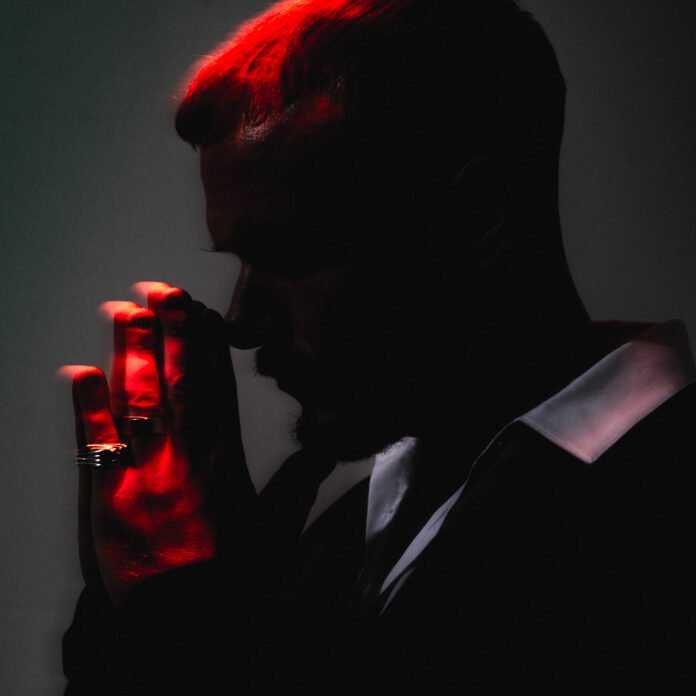
Not all music is accessible enough to be played everywhere—but it doesn’t have to. Nor is there a single, universal piece of advice that always works and leads straight to the top. “Success is feedback about the past, not instructions for the future”, says Lars Huismann, a Berlin-based producer, DJ, and one of the most important figures in today’s techno. His words convey a simple yet very important message—and looking at his releases on labels such as Soma, Mutual Rytm, Voxnox, Vault Records, and Dolly, it’s definitely worth taking to heart (and putting into everyday practice in the studio).
We discussed Lars’ latest EP—“System Collapse”—from many perspectives: the artist’s, the dance floor’s, the fans’, and that of the most demanding judge of all, Dax J. The premiere is set for September 4 on Monnom Black—and while trends in electronic music come and go, this label remains the guardian of highest quality in today’s techno.
Agata Omelańska: Hey Lars, I’m very happy to meet you! Our main topic is, of course, your new EP – but before we get into details, let’s start with something warming-up. How are you? Where have you been recently, how are you spending the summer season and what was your nicest, warmest, funniest or most memorable moment so far?
Lars Huismann: I’m in the middle of a tour through the US, Canada and Latin America right now. It started in Florida, then Mexico City, Montreal, Calgary, New York, Atlanta, Toronto, and I’m finishing here in Colombia with two shows, in Bogotá and Armenia. Next week I fly to Malta for Glitch Festival, where I play back to back with Dax J, and after that I go home to Berlin.
Then I lock myself in the studio. After the Monnom Black release, there is a release for Mutual Rytm to finish and a few other things waiting. I also work outside of music, in data science and web analytics, so that is waiting too. I’ll keep playing, but the focus for the next months will be Europe. It is simply easier when I’m living in Berlin and can finally get some work done.
The part that stays with me is Latin America. The people are kind in a way that is hard to explain, and the energy on the dancefloor is something you rarely see in Europe.
Do you have a favorite way of experiencing music? The question is not limited to your DJ’s / producer’s perspective only (and so-called „guilty pleasures” are allowed too!).
Privately, I listen to a lot of things that have nothing to do with what I play: classic house, old-school garage, early-2000s drum & bass. I’m not a fan of the modern versions of any of it, tech house or modern DnB. I like it dirty. The imperfections of early-2000s sampling have a beauty of their own and you can hear the limits of the machines people were working with, and that is exactly the part I enjoy.
When I DJ, I want to tell a story. I select tracks so the set builds and gets more intense over time, and once I have reached a certain intensity, I stay there. I don’t go back down.
That is also how I want to hear it as a listener on the floor. Nothing kills a set faster for me than a DJ who reaches peak energy and then, suddenly, goes deep.
How do you discover new music, artists or genres? How do you know that the music you hear has potential and becomes your new release or a part of your set, podcast or mix?
Mostly through promos, and through friends who send me unreleased tracks. Within the sphere I move in, there are two kinds of techno: the groovy, bouncy one and the rolling, hypnotic one. I prefer the hypnotic one, because it works like a train that pulls you through the set. I also mostly play around 143–145 BPM, which is not ideal for groovy material anyway.
I also look for trippy tracks with a lot of atmosphere and reverb. Those are usually deeper in terms of drums, so I layer them with more energetic tracks that carry the foundation. And I’m not a big fan of too much melody in a set. Sometimes, yes. But on the floor it is mostly not necessary.
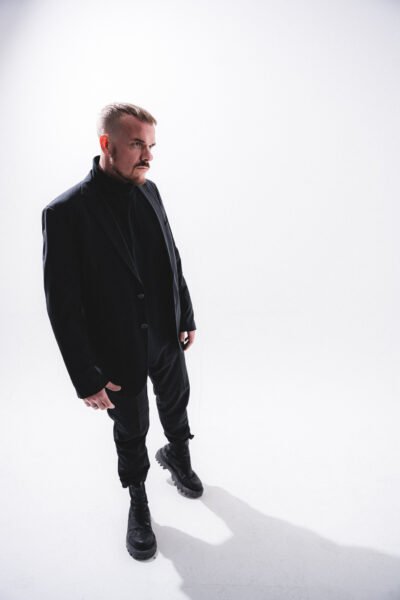
And now let’s turn the previous question around: who discovered your potential as an electronic music artist? Your background as a drummer surely has played an important role in your music and influenced your style, but I wonder who supported you in your early beginnings.
I started producing with Cubase and FL Studio around 2010 and there was no one guiding me. Most of my friends were into completely different genres. I was playing in a band at the time, and had been for years before that. Playing concerts was great, but I never enjoyed clubbing in indie, rock or metal venues and seeing a DJ play instrumental music in that context never made sense to me. So I started going to techno parties early, Tresor and Berghain, and that is where the influence came from. I went out, I paid attention and I put in the work. It was a different time.
The first person who really pushed me was Martin. In 2014 we sat down together and released a vinyl as MLLH — techno-inspired, but more house and dub influenced. He got me deep into old-school dub techno, and that still defines my sound today.
The drumming came before all of it. I started at eleven and played in jazz and progressive metal bands for around fifteen years. Those two schools taught me opposite things. Jazz is fluid and built on improvisation, so you learn how a pattern evolves and how to build tension and then release it. Progressive metal is the other extreme: odd time signatures, speed, precision, no room for error. Both of those sit underneath everything I make now.
The important part was learning what to leave out. Jazz and metal are about constant change and a lot of information. Techno wants the opposite.
It has to pull the listener into a trance, so the groove has to stay interesting without ever getting busy. That balance is what I really took from drumming, more than any specific pattern.
And how did your vision of techno evolve among the years? How do you perceive „trends” in the electronic music industry?
Musically, the direction was clear to me early. The aesthetic took much longer. That only really landed with the “Sounds From The Past” trilogy, where I went all in on tape, external hardware filtering and sampling. Since then I have been moving into darker and harder territory without giving up that old-school foundation.
As for trends: I’m rarely on social media apart from posting, and I don’t follow them. They come and go. I have been fairly consistent about just doing my own thing.
I have been told more than once that my music is not accessible enough to play everywhere. That’s accurate, because a sound built to be itself fits some rooms completely and others not at all.
I stopped caring a long time ago about what is trendy or what people supposedly want to hear. I do my thing and somehow it works out.
Speaking about the essence of your style, it’s a perfect time to put the focus on your upcoming EP – „System Collapse” will be released on 4th September at Dax J’s Monnom Black. What was the concept for this EP? And does the fact that you’re coming back to this label makes this release special?
The first record laid the foundation. The connection itself goes back further: Dax had played ‘Cope’, a track of mine from Steffi’s label Dolly — we got in contact, and a year later I was releasing “Mechanized”.
I had been following Monnom Black since the beginning, and the label always had a very unique sound and, more importantly, consistency, which you cannot say about most labels. Coming back now, with that trust already built, is what makes this one special to me.
“System Collapse” sits on the same foundation as “Mechanized”, and the clearest thread between them runs through the dub side: both records carry three dubbed-out tracks. On the new one, ‘Atonal’ is the deeper cut, while ‘Grid’ and ‘Anomaly’ take that same language up to full peak-time pace. Around that thread, the record deliberately spreads wide. Every track has its own character and job. ‘Neon Shadows’ is the standout for me. It has uplifting melodies, and the whole challenge there was finding the balance: enough melody to carry the track, not so much that it turns cheesy.
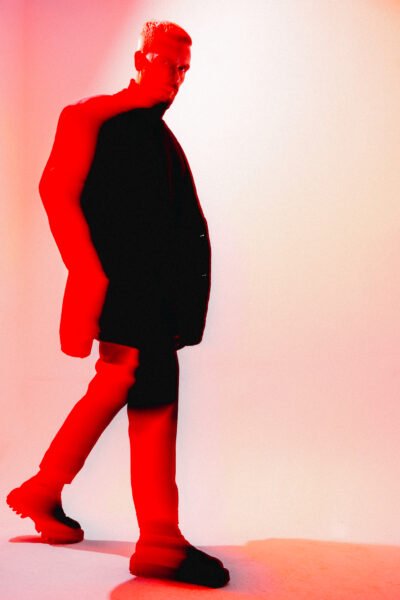
The sound design decides it. For melodies I reach for FM synthesis: FM always carries a metallic core and a hint of detune — it never sounds fully clean, and that small wrongness is exactly what keeps a melodic track dark instead of sweet. The ear locks onto it instinctively, much faster than onto a polished wavetable patch everybody already knows. Remco Beekwilder is a good example of someone who uses FM on almost every track, and they slap properly.
As for the concept question: people imagine you sit down and design an EP. In reality the whole thing is a journey and an evolution over time. Concepts show up for single tracks, rarely for a whole record — that is easier with minimal techno or with atmospheric, experimental releases.
I never produce tracks purely for listening or as an experimental showcase. Everything I make is built for the dancefloor.
How long have you been working on „System Collapse”? Production-wise, which part of the process you like the most, and which one do you consider the most challenging?
A bit more than a year. And ‘Neon Shadows’ is actually quite an old track — 3–4 years, maybe. I finally finished it when Dax showed his interest. Over that time I produced many versions of it, and of the others too.
Dax is very picky and he has a lot of experience as a listener when it comes to whether something is genuinely unique. That made the whole process long and involved a lot of work, but I appreciate it, because it pushes you to get the most out of the art.
The part I enjoy most is the beginning: finding the one signature element the whole track is built around. It is usually not the drums… it is a synth sound, a texture, sometimes a sample. Once that exists, everything else has a direction and the drums follow. The hardest part is the last ten percent, deciding that a track is actually finished. I will leave a project alone for months and open it again like a wine, and often that is the only way to hear what is still missing.
This question can be a tricky one, I know, but: if you could describe „System Collapse” not from the artist’s perspective, but from the listener’s or the dancer’s, what is this EP about? What’s the very first element of the music that can be noticed, or the emotion that is hidden between the sounds?
The very first thing you notice is light where you expected darkness. The record opens with ‘Neon Shadows’, and if you press play on a Monnom Black EP called “System Collapse”, a hopeful melody is not what you brace yourself for. That contrast is the first hook. You don’t need to know how it’s built; you just feel several melodic lines folding into one rising movement, quite 90s, that dark rave feeling with something uplifting sitting on top.
From a dancer’s perspective, the record is not about one moment you wait for. There is no big drop to point at — there is a little break, yes — but the point is being pulled along and staying in.
The emotion hidden between the sounds lives somewhere between tension and hypnosis: pressure that never fully releases, and underneath it that small stubborn light from the opening track.
It works better the longer you stay on the floor. Leave after twenty minutes and you heard some tracks. Stay, and you get the actual record.
Your debut release at Monnom Black, „Mechanized EP”, was highly praised and well-acclaimed by both the industry and dancefloors. Did you feel that the new release must reach much more than the previous one? Become better, more popular, more appreciated by others? Or you don’t let people’s expectations influence your music and attitude towards it?
The way “Mechanized” was received made me very happy. When a record sells out and gets repressed, when DJs you respect play it and strangers write to you that a track carried their night, that is not something I take for granted. I’m grateful for every bit of it.
But gratitude and pressure are two different things, and I try not to let one turn into the other. I just go with the flow and see what happens. The moment you start producing against other people’s expectations, you make a worse record. I’m convinced of that. You start second-guessing instincts that were never meant to be questioned, you sand off the edges that made people care in the first place, and you end up chasing a copy of your own past instead of following what excites you now. The audience feels that immediately.
Ironically, the surest way to disappoint the people who loved the first record is to try too hard to please them with the second.
So “Mechanized” did well, and I’m thankful for it, but it tells me nothing about what the next one should sound like. Success is feedback about the past, not instructions for the future. What I can control is the part that happens alone in the studio: I make what I want to hear and what I feel, as honestly as I can, and I hold it to my own standard. Everything after that, the charts, the reactions, the numbers, is out of my hands. It either connects or it doesn’t. Both records were made exactly the same way: with no one else in the room. That is the only method I trust, and if “System Collapse” reaches people the way “Mechanized” did, it will be because of that.
And what, actually, influences you as an artist? Where do you draw inspiration from?
The honest answer is: I don’t need that much external input. I work the other way around. After a touring stretch like this one, I lock myself in the studio, close the door, and let out what has accumulated and there is always more waiting than I have time for.
I think that comes from the drumming. When you start at eleven and spend fifteen years playing in bands, rhythm stops being something you think about and becomes something that runs in the background permanently. Like a process you can’t switch off. I hear grooves in everything: a train over the tracks, a loose fan, machines, footsteps in a stairwell, the loops of everyday life. I don’t write these things down. They sink in somewhere, and weeks later they come back out of my hands as a pattern, and I usually can’t even tell you where it came from.
That’s what I mean by intuitive: the input happens by living, not by studying. And touring feeds it more than any playlist could.
Inspiration has never been the bottleneck for me. Ideas are the cheapest part of the process; I have more sketches and half-finished loops than I could release in many years. The bottleneck is structure. The right workflow, the discipline to actually sit down at a fixed time and treat it like work, dedicated recording weeks where I only build sounds, then phases where I only write, then the ugly last ten percent where a track has to be finished instead of started. None of that is romantic, and that is exactly the point. Waiting for the muse is how sketches stay sketches. Sometimes you simply have to force yourself into the studio and the strange thing is, the ideas always show up about ten minutes after you do.
Which of your tracks became successful and you never expected it to?
‘Functions’, from “Mechanized”, my first Monnom Black EP. It was the best-selling track on the record, and I did not see that coming at all.
I left this one as the last for a purpose. Please finish the sentence: „A good DJ can be recognized by…”
…telling a story on the dancefloor. There are dozens of technically brilliant DJs, but what stays with you afterwards is the whole set: the atmosphere, the arc, the experience. Not the single moment.
Thank you so much for the interview and time dedicated, Lars. Congratulations for your new EP, may it bring you a lot of joy, success and self-realisation!