



26 Rue Hélène et François Missoffe – Paris, France
Virage is one of the most unusual venues to emerge from the recent revival of Parisian electronic music. Located at 26 Rue Hélène-et-François Missoffe, near Porte de Saint-Ouen, the club occupies a former vehicle impound beneath the Boulevard Périphérique — turning a residual piece of transport infrastructure into a large semi-open electronic music venue.
Opened in 2022, Virage belongs to a new generation of Paris clubs that moved electronic music away from the traditional nightlife districts of the city centre. Like Kilomètre25 and later Mia Mao, it uses the infrastructural landscape surrounding Paris — ring roads, industrial zones and overlooked urban spaces — as part of the club itself.
Under the Périphérique
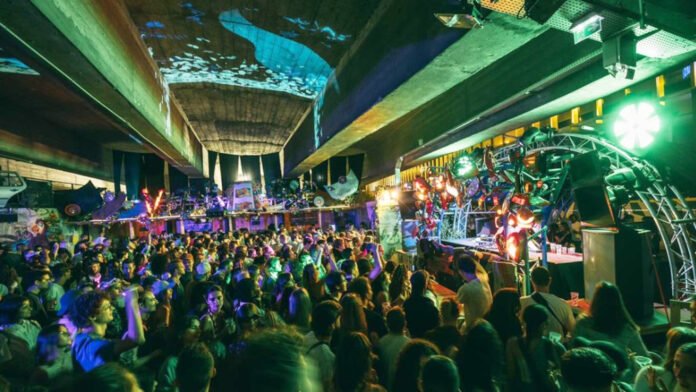
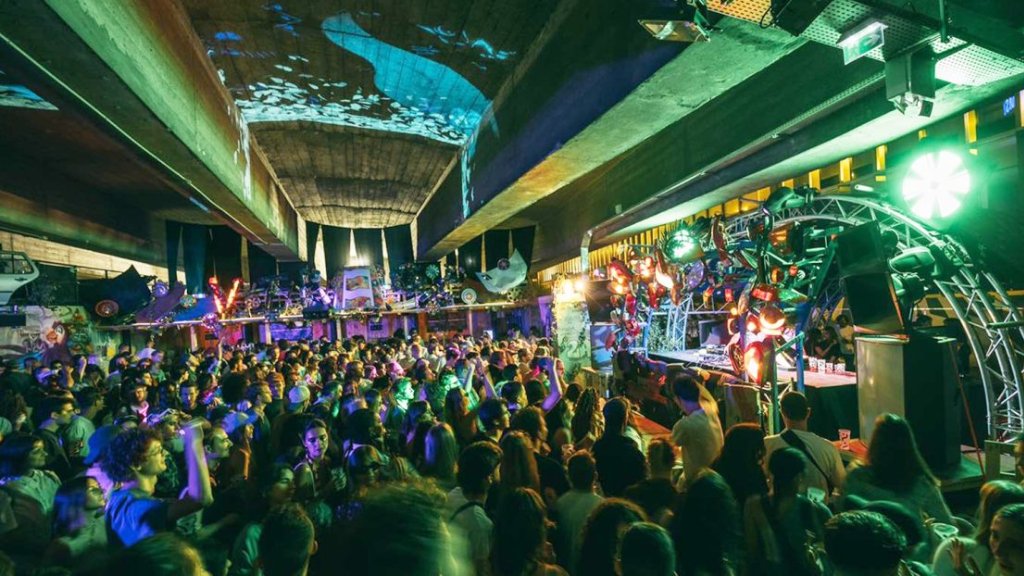
The architecture is what immediately separates Virage from a conventional nightclub. The enormous concrete structure of the Périphérique effectively forms its roof, while the former impound lot underneath provides a long, open volume somewhere between a warehouse and an outdoor club.
Instead of hiding this environment, Virage incorporates it into its identity. Concrete columns, road infrastructure and the unusual proportions of the site remain visible, supplemented by a scenography created by Adrien Utchanah of Studio Outchesque. The result feels less like a building containing a nightclub than a temporary occupation of infrastructure never originally intended for dancing.
This semi-open configuration also makes Virage strongly seasonal. Its programme is concentrated around the warmer part of the year, when the boundary between club and open air becomes particularly important.
Music and Community
From its opening, artistic direction was developed by Rag and Benjamin Charvet, with Rag taking full responsibility for artistic direction in 2025. A DJ and producer whose background is closely connected with gay club culture, she helped establish Virage as an explicitly inclusive venue rather than simply another large techno space.
The programming consequently extends beyond one interpretation of techno. House, acid, electro, trance, disco, bass and more experimental club music coexist with harder electronic sounds, while queer collectives and independent Paris promoters regularly take control of the space.
Early events already demonstrated this approach. In 2022, Spectrum, an LGBTQ+ collective, brought Lady Starlight, STERAC, Lea Occhi and Corbeille Dallas to Virage, while another night hosted La Mamie’s alongside CC:DISCO! and Earl Jeffers. The combination of international artists, established Paris collectives and queer communities became characteristic of the venue.
Virage also places considerable emphasis on safer clubbing. Its policies explicitly reject racism, sexism, misogyny, homophobia and transphobia, reflecting a wider transformation of contemporary Parisian nightlife in which inclusivity, consent and harm reduction have become increasingly integrated into club operations.
A New Geography of Paris Nightlife
Virage is particularly interesting when considered alongside Kilomètre25 and Mia Mao. All three demonstrate how Parisian electronic music has increasingly moved towards the edges of the traditional city.
For decades, central Paris presented difficult conditions for large underground clubs: expensive property, dense residential neighbourhoods and strict noise constraints limited the availability of suitable spaces. The areas around the Périphérique offered another possibility. Transport infrastructure, former industrial land and large unused spaces could accommodate louder and longer events while creating environments radically different from traditional Parisian nightlife.
Virage takes this logic almost literally. The road above is not simply near the club — it is part of its architecture.
The location also creates an interesting inversion of the conventional relationship between club and city. Rather than entering a sealed basement and forgetting the surrounding environment, visitors remain conscious of the infrastructure overhead. The physical machinery of Paris — concrete, roads, columns and traffic — becomes part of the visual language of the night.
Present
Virage remains part of the broader resurgence of electronic club culture that has transformed Paris since the pandemic. Alongside venues such as Mia Mao and Kilomètre25, it has helped establish the northern and northeastern edges of the city as important territories for a younger generation of dancers, promoters and queer communities.
Its identity, however, remains particularly tied to its location. There are larger clubs, darker clubs and venues with longer histories, but relatively few where the urban infrastructure itself is so central to the experience.
Virage demonstrates one of the recurring abilities of electronic music culture: to look at a piece of city designed for an entirely different purpose and imagine a dancefloor there.
In this case, an abandoned vehicle impound beneath one of Europe’s busiest urban motorways became a club.