




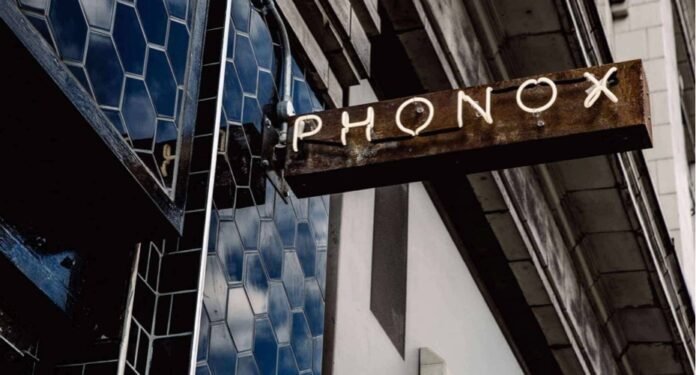
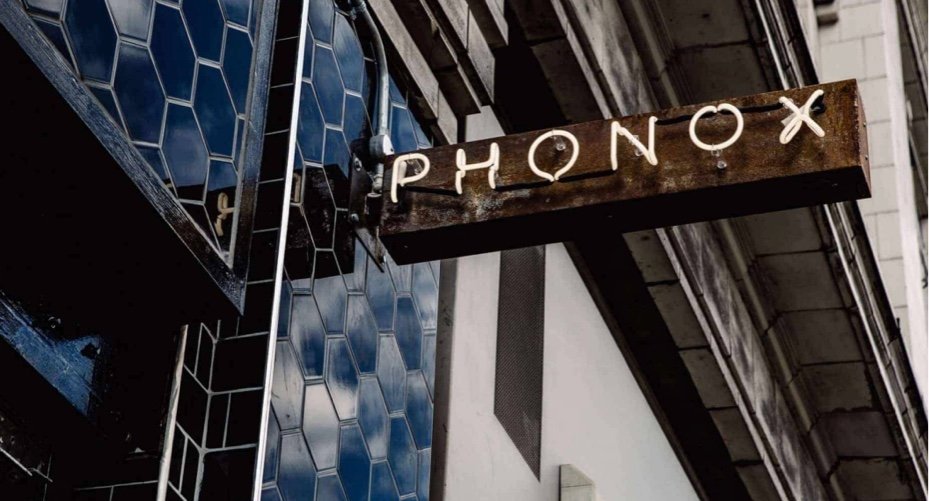
418 Brixton Rd – London SW9 7AY, United Kingdom
Phonox is one of the key electronic music clubs in South London. Located on Brixton Road, only a few minutes from Brixton Underground station, the venue has built its identity around a deliberately simple formula: one dancefloor, a powerful sound system, carefully selected DJs and enough time for artists to develop a proper musical journey.
Opened in 2015, Phonox arrived during a period when London nightlife was under increasing pressure from redevelopment, rising property values and club closures. Rather than competing through scale, multiple rooms or spectacular production, it adopted a back-to-basics philosophy that has remained central to the club for more than a decade.
From Plan B to Phonox
Phonox occupies 418 Brixton Road, a location that already had a history in South London nightlife.
Before Phonox, the building was home to Plan B, a club and live music venue that became part of Brixton’s nightlife during the 2000s and early 2010s. Plan B hosted a broad mixture of electronic music, live performances and club nights before eventually closing.
The space was subsequently taken over and extensively redesigned, reopening as Phonox in September 2015.
The new project was connected with the team behind several London nightlife venues, including XOYO and The Nest. Instead of preserving the multi-purpose identity of Plan B, Phonox was conceived much more specifically around the dancefloor.
The concept was intentionally restrained. A single principal room replaced the idea of moving between numerous competing environments, while the DJ booth, lighting and sound system became the focus of the space.
With a capacity of roughly 500 people, Phonox occupies an interesting middle ground within London nightlife. It is large enough to host internationally established artists but still small enough for the relationship between DJ and audience to remain direct.
The Residency Model
One of the most distinctive elements of Phonox from the beginning was its approach to DJ residencies.
Scottish DJ Jasper James became the club’s first Saturday resident when Phonox opened in 2015. Rather than booking a different major headliner every weekend, the residency allowed one artist to repeatedly play for the same audience and gradually develop a relationship with the room.
This idea was important to the club’s identity.
Traditional club residencies had historically played a fundamental role in electronic music culture, allowing DJs to understand a particular sound system and audience over months or years. By the mid-2010s, however, much of international nightlife had moved towards festival-style programming based on constantly changing headline names.
Phonox deliberately revived the older model.
HAAi became another particularly important resident. Beginning her Saturday residency in 2016, she played regularly at Phonox for two years, a period that became closely connected with her development from a relatively unknown London DJ into an internationally recognised artist.
Other residents and recurring selectors have subsequently brought very different musical identities into the room, allowing the club itself to remain stylistically flexible.
The residency concept later developed into formats such as “4 Fridays at Phonox”. A selected artist takes control of every Friday across a month, inviting guests for some nights and often concluding the series with an extended or all-night-long set.
This gives artists something increasingly rare within contemporary club culture: time.
Music
Phonox is sometimes described primarily as a house and techno club, but its programme has always been considerably broader.
Over the years, the booth has hosted artists including Laurent Garnier, Optimo, James Blake, Midland, Hunee, Palms Trax, DJ EZ, Call Super, Sherelle and Objekt, representing very different areas of electronic music.
House and techno remain important foundations, but disco, electro, UK garage, bass, breaks, dub, experimental club music and sounds from outside the conventional European electronic canon regularly appear in the programme.
This diversity is partly a consequence of the residency model. Instead of forcing every night into a predetermined Phonox sound, the club allows individual selectors to temporarily shape its musical identity.
A DJ associated with house may therefore occupy the same booth that, on another weekend, hosts UK garage, techno or much more experimental music.
The continuity comes from the format rather than the genre.
One Room, One Soundsystem
The physical philosophy of Phonox is equally straightforward.
The club is centred around a single dancefloor equipped with a Funktion-One sound system. Lighting is relatively restrained, with the large disco ball above the room becoming one of the venue’s most recognisable visual elements.
There is no need to navigate an enormous complex or choose between several simultaneous headline performances. Once inside the main room, everyone is essentially participating in the same event.
This architecture supports extended DJ sets particularly well.
Rather than repeatedly interrupting the atmosphere as artists change every hour or two, Phonox frequently gives DJs an entire night. Sets lasting five, six or more hours allow the musical energy to develop gradually.
On special occasions the format becomes even longer. During its tenth-anniversary programme, A Love From Outer Space and Palms Trax were among the artists invited to play ten-hour sessions.
In this sense, Phonox shares something with clubs such as Guesthouse in Bucharest despite the obvious musical differences between them: the belief that time itself can be an important part of club design.
Brixton
The location is also fundamental to the club’s identity.
Brixton has one of London’s richest musical histories. Caribbean migration after the Second World War profoundly shaped the area’s culture, bringing sound-system traditions, reggae and dub into a neighbourhood that would later become associated with punk, hip-hop, electronic music and numerous forms of independent nightlife.
Phonox exists within this wider musical environment rather than London’s more obvious central nightlife districts.
Brixton Academy sits nearby, while record shops, bars, small venues and restaurants form part of the surrounding cultural ecosystem. The neighbourhood has changed dramatically through gentrification, but music remains one of the strongest elements of its identity.
For Phonox, being a neighbourhood club in South London is therefore important. It does not have the industrial isolation of many Berlin venues or the enormous destination-club scale of Ibiza. It sits directly on a busy urban street, surrounded by the everyday life of Brixton.
Dancefloor Culture
Phonox also places emphasis on keeping attention on the dancefloor.
Photography and video are strongly discouraged inside the club. Rather than operating as an absolute phone ban, the policy asks visitors to avoid filming and photographing so that screens do not dominate the room.
The venue also explicitly promotes an inclusive environment and maintains zero tolerance towards harassment and discrimination.
These policies form part of the same relatively simple philosophy that informs the club’s design: remove unnecessary distractions and allow the dancefloor, music and people inside the room to provide the experience.
Phonox therefore occupies an interesting position between underground club culture and an accessible city nightclub. It has internationally recognised bookings and professional production, but avoids many characteristics of the large commercial club model — VIP-focused architecture, elaborate stage spectacle and constant emphasis on headline artists.
Ten Years of Phonox
In 2025, Phonox celebrated its tenth anniversary with a year-long programme that also demonstrated how broad its musical identity had become.
Nicolas Lutz and Call Super played all-night-long sessions, A Love From Outer Space and Palms Trax were given ten-hour sets, while other anniversary events featured artists including Objekt, Pangaea, Amaliah, Mount Kimbie, D. Tiffany and Manuka Honey.
The anniversary was significant in the context of London nightlife.
Many clubs that existed when Phonox opened in 2015 have since disappeared, while the city continues to face conflicts around property development, licensing, operating costs and noise. Surviving for a decade in the same South London location therefore represents a considerable degree of stability.
Present
Today, Phonox remains at 418 Brixton Road and continues to operate primarily on Friday and Saturday nights.
Friday programming frequently uses the multi-week residency format, giving an artist control over a sequence of events and allowing them to invite their own guests. Saturdays retain an even simpler principle: one dancefloor, one Funktion-One system and DJs playing extended or all-night-long sets.
More than ten years after opening, this simplicity remains the club’s strongest characteristic.
Phonox has never attempted to become London’s biggest club. Instead, it has built its reputation around the idea that a relatively small number of elements — a carefully chosen DJ, a good sound system, a dark room and enough time — can still provide everything a nightclub needs.
In a city where nightlife is constantly changing, that consistency has turned Phonox from a new Brixton venue into one of the established institutions of contemporary London club culture.
