



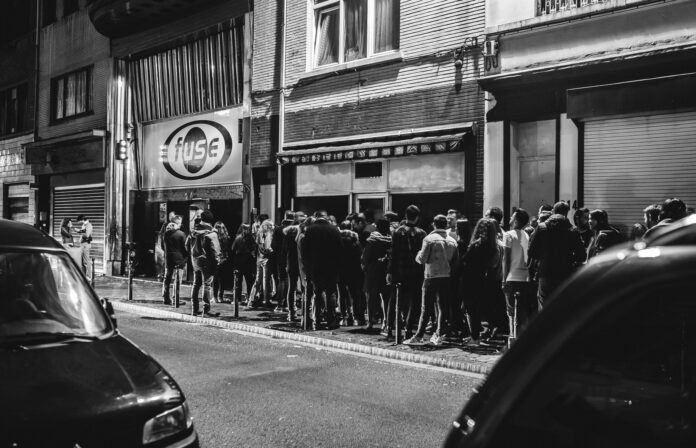
Rue Blaes 208 – Brussels, Belgium
Fuse is one of Belgium’s most important electronic music clubs and one of the longest-running techno institutions in Europe. Located in the Marolles district of central Brussels, the club has operated since 1994 and played a major role in establishing the Belgian capital on the international techno map.
Unlike many clubs that have disappeared or repeatedly changed locations, Fuse has remained closely associated with the same building on Rue Blaes for more than three decades. Its identity is based on a combination of uncompromising electronic music, a relatively raw interior, and a programme connecting Belgian artists with successive generations of international DJs.
History
Fuse opened on April 16, 1994, founded by Thierry Coppens and Peter Decuypere, the latter already known as one of the founders of the legendary Ghent club Boccaccio. It emerged during a particularly important period for Belgian electronic music. The country had played a major role in the development of new beat during the late 1980s, while techno, house and rave culture were rapidly establishing themselves across Europe.
The club took over a former cinema and Latin nightclub in the Marolles, one of Brussels’ oldest and most distinctive neighbourhoods. From the beginning, Fuse moved towards the harder and more experimental side of electronic music, at a time when techno was still developing its permanent infrastructure outside cities such as Detroit, Berlin and London.
A central figure in the club’s history was Pierre, who became its resident DJ and artistic director. Through regular nights and international bookings, Fuse established connections with the rapidly expanding European and American techno scenes. Artists including Jeff Mills, Laurent Garnier, Dave Clarke, Richie Hawtin and many other defining figures of the genre appeared at the club, often repeatedly over the course of its history.
One of Fuse’s most important long-term relationships developed with Dave Clarke. The British DJ became closely associated with the venue and hosted numerous editions of his Fuse residency and event series, reinforcing the club’s reputation far beyond Belgium.
The building itself became an important part of the experience. Rather than transforming into a polished superclub, Fuse retained an intentionally functional character: dark rooms, narrow passages, concrete surfaces and a strong focus on the sound system and dancefloor. Over time, its main room became particularly associated with intense, stripped-down techno.
The Noise Dispute
In January 2023, Fuse unexpectedly announced that it would close after receiving new restrictions concerning noise levels following complaints from a neighbour. Authorities imposed a maximum sound level of 95 dB and required the club to close at 2 a.m., conditions that effectively made normal club operations impossible.
The announcement generated a major reaction from the Belgian and international electronic music community. Thousands of people signed petitions supporting the club, while artists, cultural organisations and nightlife representatives argued that long-established music venues needed stronger protection from conflicts resulting from changing residential environments.
The dispute quickly developed into a broader discussion about the status of nightlife as culture and the future of clubs in increasingly residential European city centres. Fuse was subsequently able to reopen while negotiations and legal procedures continued, and the case became an important example in the European debate around the “agent of change” principle — the idea that new developments around existing cultural venues should be responsible for adequate sound insulation rather than forcing established venues to reduce their activities.
Present
Today, Fuse remains at its historic location at 208 Rue Blaes. More than thirty years after opening, it continues to operate primarily as a techno club while allowing space for house, electro and other forms of underground electronic music.
The club consists of multiple rooms with different capacities and atmospheres. The main room remains the centre of its identity, designed around a powerful sound system and a relatively minimal visual environment. Rather than relying on elaborate decoration or large-scale production, Fuse maintains the classic architecture of a European underground club: DJ, sound system and dancefloor as the essential elements.
Its programming combines major international artists with Belgian DJs and emerging talent. Over three decades, generations of artists have passed through the booth, making Fuse an unusual point of continuity between the techno culture of the 1990s and contemporary electronic music.
Fuse is also closely connected to the wider cultural identity of Brussels. The city sits geographically between several historically important electronic music centres — Detroit-influenced techno arriving through European networks, Belgian new beat and rave culture, French electronic music, and the scenes of Amsterdam, London and Berlin. Fuse became one of the places where these influences consistently met.
While Brussels now has a much broader ecosystem of clubs, collectives and temporary cultural spaces, Fuse remains one of its foundations. Its longevity is particularly significant in a nightlife landscape where venues frequently disappear because of redevelopment, rising property values and noise restrictions.
More than simply a surviving 1990s techno club, Fuse represents an unusually continuous piece of European club history. Few venues from the first major wave of continental techno culture have remained active for so long, in the same location and with essentially the same purpose. That continuity has made Fuse both a functioning contemporary club and an institution within Belgian electronic music.
