



Bij Sint-Jacobs 13 – Gent, Belgium
Funke is one of the smaller but more distinctive spaces in Ghent’s contemporary electronic music scene. Located at Bij Sint-Jacobs 13 in the historic centre, it combines a nightclub, bar, exhibition space and cultural meeting point inside a nineteenth-century townhouse. Rather than competing with the scale and industrial intensity of venues such as Kompass, Funke has built its identity around intimacy, adventurous programming and a close relationship with the local community.
The venue describes itself as a “polymorphous bar & a clubhouse” for dancers, curious visitors and dedicated audiophiles. The description captures its character well. Funke is not simply a nightclub that opens after midnight: people can arrive earlier for drinks, food, exhibitions or other cultural activities before the building gradually shifts towards its nighttime function. Across several floors, spaces of different sizes create an environment closer to a cultural house than a conventional single-purpose club.
Bij Sint-Jacobs
Funke occupies a nineteenth-century building on Bij Sint-Jacobs, one of Ghent’s historic squares. Long before electronic music arrived, the building had already passed through several identities, including a townhouse, the Meubelen Rita furniture shop, a people’s café and a traditional Belgian brown pub. Rather than replacing this history with the anonymous interior of a modern nightclub, Funke makes use of the building’s domestic proportions and irregular structure.
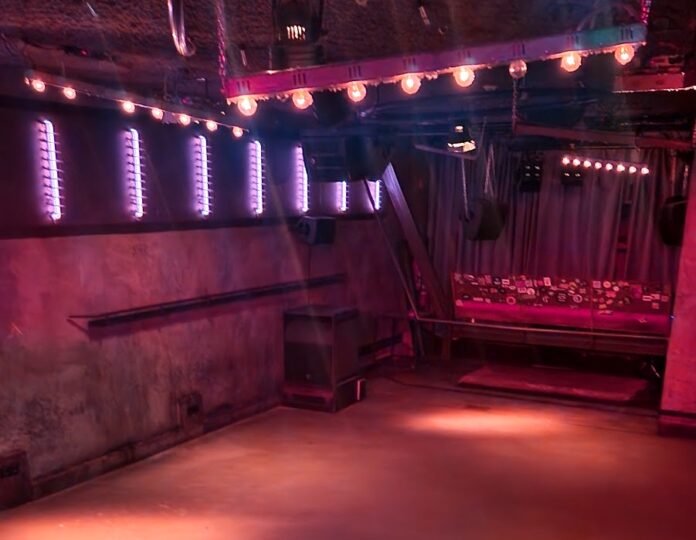
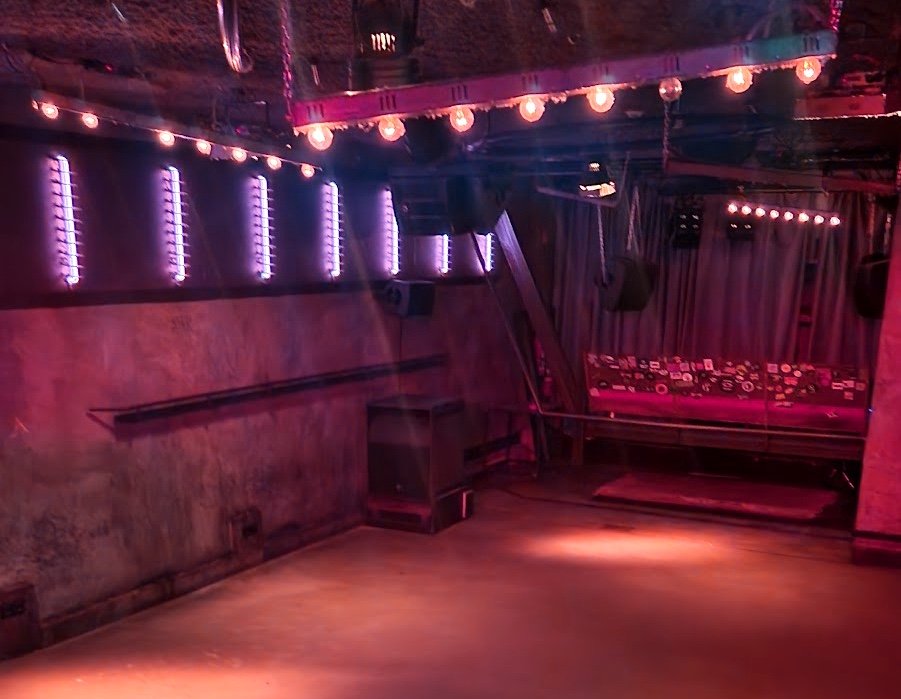
This location separates Funke from the industrial geography associated with much of contemporary techno culture. There is no peripheral warehouse district or enormous former factory surrounding it. The club sits directly within the existing urban fabric of Ghent, close to bars, cafés, cultural spaces and the dense pedestrian life of the old city. Inside, however, the building becomes progressively less conventional. Its multiple floors contain a compact nightclub, bar, exhibition areas and numerous smaller corners and transitional spaces.
The scale is essential to the atmosphere. Funke is a small-capacity venue where DJs and dancers remain physically close and where the audience can move easily between the dancefloor and more social parts of the building. This gives it something of a living-room quality, an association also made by artists connected with the venue. The club can feel less like an anonymous destination and more like a recurring meeting place for overlapping parts of Ghent’s electronic music community.
Music
Musically, Funke has deliberately avoided defining itself through a single genre. Techno, house and minimal are important, but its programme has consistently extended into electro, dub, breaks, bass, jungle, experimental electronics, psychedelic sounds and live performance. The relatively small room allows the club to take risks that would be considerably more difficult in a venue dependent on selling thousands of tickets.
Its early programmes already demonstrated this breadth. Artists including Wata Igarashi, Call Super, Rhadoo, Nicolas Lutz, Shifted, OK Williams, Takaaki Itoh, Kahn, Pantha du Prince and Ceephax Acid Crew appeared alongside Belgian residents, local selectors and emerging artists. Some guests were invited for extended or all-night sets, giving them the opportunity to explore beyond the short, functionally defined sets common at larger events.
The diversity is not accidental. Funke has repeatedly worked with local promoters and collectives rather than building its calendar exclusively around its own bookings. Collaborations have included organisations such as Ojoo, Butternut, Radio Ruit, Music Mania and other participants in Ghent’s independent cultural ecosystem. This gives individual nights distinct identities while allowing the venue itself to remain stylistically open.
The result is a club where consistency comes less from genre than from selection. A visitor may encounter hypnotic techno on one weekend, minimal and house on another, followed by bass music, experimental live electronics or a programme that moves between several of these areas during the same night.
A Clubhouse Rather Than a Club
The idea of a clubhouse is particularly useful for understanding Funke. During its earlier years, the programme included not only club nights but concerts, exhibitions, screenings, workshops, markets, jam sessions and free DJ sets. Food and drinks were presented as part of the programme rather than merely services surrounding it.
This multidisciplinary approach continues in the way the building is organised. Het Verdiep, one of its upper spaces, can function as an exhibition and event floor, allowing visual art and other cultural activities to coexist with the club below. Funke also organises workshops and provides opportunities for artists and other creators to use the space.
The model places Funke within a long European tradition of small independent venues where nightlife overlaps with other forms of cultural production. Instead of separating gallery, bar, concert venue and nightclub into different institutions, the same building can change function over the course of a day or week.
That flexibility is particularly valuable for emerging scenes. A young DJ does not necessarily need to enter the club through the same booking hierarchy as an international touring artist. They can become connected through workshops, local collectives, radio, exhibitions or simply by repeatedly participating in the community surrounding the venue.
Residents and the Ghent Scene
Funke’s resident culture reinforces this local focus. Rather than treating residents merely as DJs who fill gaps around international bookings, the venue has used them to represent different parts of Ghent’s musical ecosystem and to develop continuity between individual nights.
Interviews with Funke residents reveal how closely these artists are connected with the wider history of nightlife in the city. Many moved through venues such as Decadance and Kompass, local collectives, DJ schools, radio projects and independent parties before becoming associated with Funke. Their careers illustrate how a relatively compact city can support several overlapping generations of electronic music culture.
Resident Ampe, for example, has described Funke as a breeding ground for different genres and emphasised its importance as a place where community creates trust in unfamiliar music. This idea explains much of the club’s programming philosophy. An adventurous line-up becomes easier to sustain when audiences visit because they trust the venue rather than because they recognise every artist on the poster.
This is one of the major differences between a community club and a conventional booking-driven venue. The line-up remains important, but the identity of the room can become equally significant. People return because they understand what kind of environment the organisation is trying to maintain.
Sound and Listening
Funke explicitly positions itself as a place for dedicated listeners as well as dancers. The distinction matters because its eclectic programming often depends on music that cannot be reduced to conventional peak-time club functionality.
In a small room, subtle changes in rhythm, texture and dynamics can have as much impact as sheer volume. Extended DJ sets can move between different tempos and styles without losing contact with the audience, while less familiar music has room to develop gradually. The proximity between booth and dancefloor further reduces the separation between selector and crowd.
This listening-oriented philosophy connects Funke with a wider tendency in European club culture. Venues such as Doka in Amsterdam approach nightlife partly through audiophile listening culture, while record stores, online radio stations and independent labels increasingly overlap with club communities. Funke follows a similar principle without becoming a dedicated listening bar: sound remains something to pay attention to, but dancing is still central to the experience.
Art and Experimentation
Visual art and experimental cultural activity have been present at Funke since its early programme. Exhibitions have occupied the building alongside club nights, while workshops, screenings and collaborative events allow the space to function outside conventional nightlife hours.
This is significant because small clubs are increasingly important pieces of cultural infrastructure. Large venues can bring international artists into a city, but smaller spaces provide opportunities for experimentation, early performances and relationships between people who may later create their own labels, parties or artistic projects.
Funke’s relatively informal structure makes these encounters possible. An exhibition visitor can discover a DJ set, a club regular can encounter a live performance, and artists working in different disciplines can share the same physical space. The boundaries between audience, artist, promoter and organiser consequently become less rigid than they would be in a larger commercial venue.
Safer Space and Community
Community building is also reflected in Funke’s approach to nightlife policy. The venue explicitly emphasises respect, consent and collective responsibility and reserves the right to refuse entry or remove visitors whose behaviour threatens the atmosphere of the space. Staff encourage visitors to approach them when something feels wrong and frame safety as something maintained collectively rather than solely through security personnel.
These principles are particularly relevant in a small venue. When only a limited number of people share a dancefloor, individual behaviour has a disproportionate effect on the atmosphere. Maintaining a welcoming environment therefore becomes part of the curatorial process alongside selecting artists and designing the programme.
Funke’s resident community has also connected the venue with broader discussions around safer spaces and accessibility within electronic music. The objective is not simply to create an underground identity through exclusivity, but to establish enough trust for different audiences and musical communities to occupy the same building.
Funke and Kompass
Comparing Funke with Kompass reveals two very different sides of Ghent nightlife. Kompass emerged from the city’s industrial periphery and became known for large warehouse spaces, monumental production and international techno programming. Its history has involved repeatedly moving between industrial locations as redevelopment and permitting issues changed the availability of suitable buildings.
Funke operates almost at the opposite scale. It sits in a historic building in the centre of Ghent, works with a much smaller audience and can move more easily between music, art and social activity. Where Kompass can create the collective intensity of thousands of dancers inside an industrial hall, Funke relies on proximity and familiarity.
The two models are complementary rather than contradictory. A healthy electronic music ecosystem needs large clubs capable of attracting major international artists, but it also needs small rooms where local communities can develop without the economic pressure of large-scale programming.
Funke’s importance lies largely in fulfilling that second role.
Present
Today, Funke continues to operate at Bij Sint-Jacobs 13, combining its bar and cultural programme with club nights on weekends. Its current identity remains deliberately broad: the organisation describes itself simultaneously as a bar, clubhouse and space for music, art, ideas and connection.
Its influence is therefore difficult to measure simply through capacity or international recognition. Funke matters because it provides Ghent with a small cultural environment in which different parts of the city’s scene can overlap. Residents, visiting DJs, collectives, visual artists and audiences do not occupy completely separate programmes but repeatedly encounter one another inside the same building.
Within Belgium, this gives Funke a distinct position. Fuse represents the historical continuity of Brussels techno. C12 connects contemporary art and electronic music beneath the centre of the capital. Kompass translates Ghent’s industrial landscape into large-scale club culture, while Horst uses a former military complex to experiment with the relationship between architecture, art and dancing.
Funke works from the other direction. Its world is compressed into a nineteenth-century townhouse in the centre of Ghent, where a bar can become a cultural meeting point and a few floors can support exhibitions, experimental music and an intimate dancefloor.
It demonstrates one of the less spectacular but essential functions of a nightclub: creating a place small enough for a scene to know itself.
