



Revaler Str. 99 – Berlin, Germany
Urban Spree is an independent cultural complex located on the RAW-Gelände in Friedrichshain, one of Berlin’s best-known former railway and industrial sites. Combining a concert venue, club, gallery, artist spaces, street art and a large outdoor beer garden, it represents the overlap between music, visual art and alternative urban culture that has shaped this part of Berlin since the 1990s.
The venue occupies approximately 1,700 square metres within the former railway repair grounds around Revaler Straße. The wider RAW site was originally developed for railway maintenance and later became one of the largest concentrations of alternative cultural projects in Friedrichshain. Following German reunification and the decline of its industrial function, former workshops and warehouses were gradually occupied by clubs, artists, bars and independent organisations.
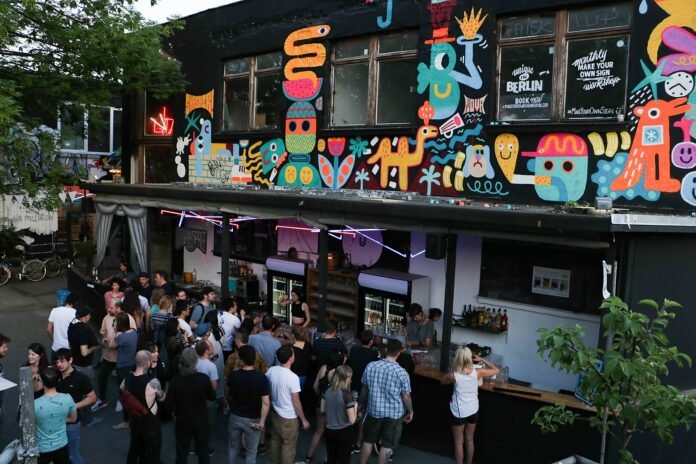
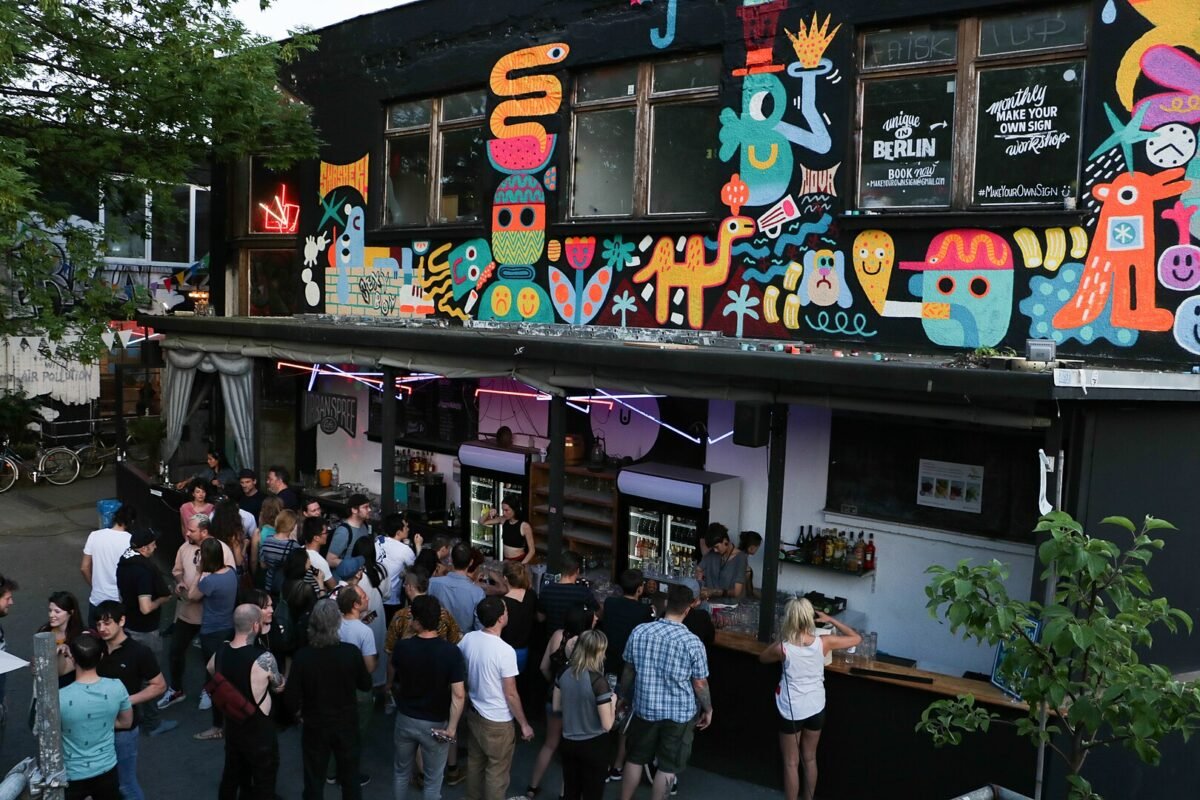
Urban Spree opened in 2012 and developed this industrial environment into a multidisciplinary cultural space. Rather than renovating the building into a polished venue, it retained much of its raw architecture. Concrete, exposed brick, graffiti and constantly changing murals became part of its identity, while the exterior walls developed into a large-scale canvas for international street artists.
Music and Art
Music at Urban Spree is deliberately broad. The programme moves between electronic music, punk, post-punk, psychedelic rock, experimental music, noise, metal and other independent scenes. Club nights coexist with concerts and live performances, making the venue considerably less genre-specific than Berlin institutions built primarily around techno.
The Urban Spree Galerie forms another important part of the project. Its programme focuses on urban contemporary art, graffiti, photography and independent visual culture, with exhibitions and murals frequently changing the appearance of the complex. Artists have also used the surrounding outdoor spaces, allowing art to become part of the architecture rather than something isolated inside a conventional gallery.
During warmer months, the large outdoor area becomes equally important. Concerts, DJ sets, markets and cultural events can extend beyond the main building, creating an atmosphere closer to an independent cultural compound than a traditional nightclub.
RAW-Gelände
Urban Spree’s location is inseparable from its identity. The RAW-Gelände developed into an important centre of alternative culture in Friedrichshain, with clubs and projects including Cassiopeia, Suicide Circus — later ÆVE — and numerous smaller organisations operating across the former railway complex.
At the same time, RAW has become an example of the pressures facing Berlin’s alternative spaces. Friedrichshain has undergone extensive redevelopment, tourism has transformed the surrounding area and former industrial properties have become increasingly valuable. Plans for the future redevelopment of RAW have consequently generated long-running debates about how much of its existing cultural infrastructure can survive.
Urban Spree therefore represents both the success and fragility of Berlin’s post-industrial cultural model. A former railway facility became a place where street art, underground music and nightlife could coexist, but the economic conditions that originally made such projects possible have largely disappeared from central Berlin.
Present
Urban Spree remains active at Revaler Straße 99, continuing to host concerts, club nights, exhibitions and outdoor events. Its significance comes less from belonging to one particular electronic music scene than from connecting several underground cultures within the same space.
Where Berghain transformed industrial architecture into a globally recognised techno institution and ACUD preserved the interdisciplinary spirit of early post-Wall Mitte, Urban Spree represents another characteristic Berlin model: the independent cultural compound.
Music, graffiti, exhibitions, nightlife and public outdoor space overlap within the remains of former railway infrastructure. In a city where such environments are becoming increasingly difficult to preserve, Urban Spree remains a visible reminder of how much of Berlin’s contemporary cultural identity grew from the temporary reuse of places that had lost their original purpose.
