




Overhoeksplein 3 – Amsterdam, Netherlands
Shelter is one of Amsterdam’s best-known dedicated electronic music clubs. Located beneath the A’DAM Tower on the northern bank of the IJ, directly opposite Amsterdam Centraal, the venue combines an unusual underground location with a programme centred primarily on house and techno. Opened in 2016, Shelter arrived during an important transitional period for Amsterdam nightlife: Trouw had already closed, De School had recently opened in Amsterdam-West, and the northern waterfront was rapidly transforming from a former industrial zone into one of the city’s major cultural and redevelopment areas.
Shelter offered a different model from many of Amsterdam’s best-known clubs. Rather than adapting a former school, newspaper printing plant or warehouse into a multidisciplinary cultural complex, it was developed specifically as a nightclub. Its architecture, sound system and infrastructure were designed around the dancefloor from the beginning. The result is one of Amsterdam’s most focused club environments, underground physically as well as culturally.
A’DAM Tower and Amsterdam-Noord
Shelter is located beneath one of the most recognisable buildings on Amsterdam’s waterfront. The A’DAM Tower was originally constructed in the late 1960s and early 1970s as an office building for Royal Dutch Shell. Known for decades as Toren Overhoeks, it formed part of Shell’s large research and office complex in Amsterdam-Noord. Its location reflected the industrial character of the northern IJ waterfront, which for much of the twentieth century was dominated by shipbuilding, docks, factories and heavy industry.
This landscape began changing significantly during the early twenty-first century. Shell gradually left the site and the Overhoeks district entered a large redevelopment process. The former office tower was acquired and transformed into A’DAM Tower, a mixed-use complex containing offices, restaurants, a hotel, observation facilities and businesses connected with music and the creative industries. Nearby, the EYE Filmmuseum had already opened its new building in 2012, helping establish the waterfront as a new cultural destination.
Shelter opened beneath the renovated tower in 2016. The location created an interesting contrast: above ground, one of the most visible symbols of the redevelopment of Amsterdam-Noord; underneath it, a dark nightclub designed to disconnect visitors almost completely from the city outside. Despite technically being in Noord, the venue is also exceptionally accessible from central Amsterdam. The free Buiksloterweg ferry crosses the IJ from behind Centraal Station, placing Shelter only a short journey from the historic centre.
Going Underground
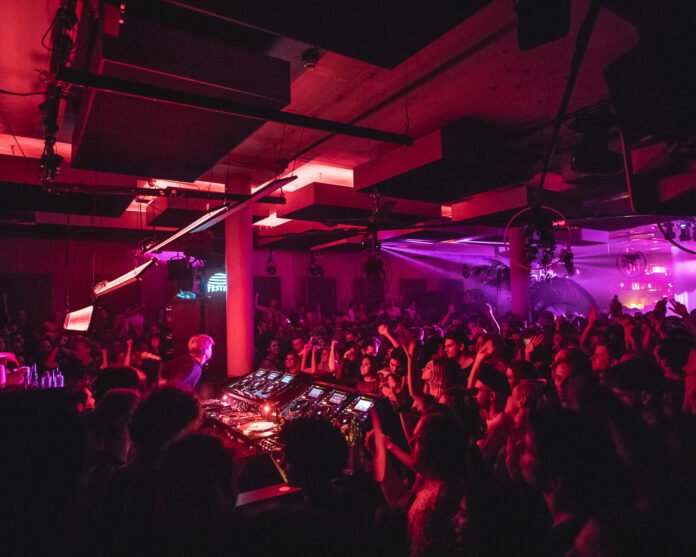
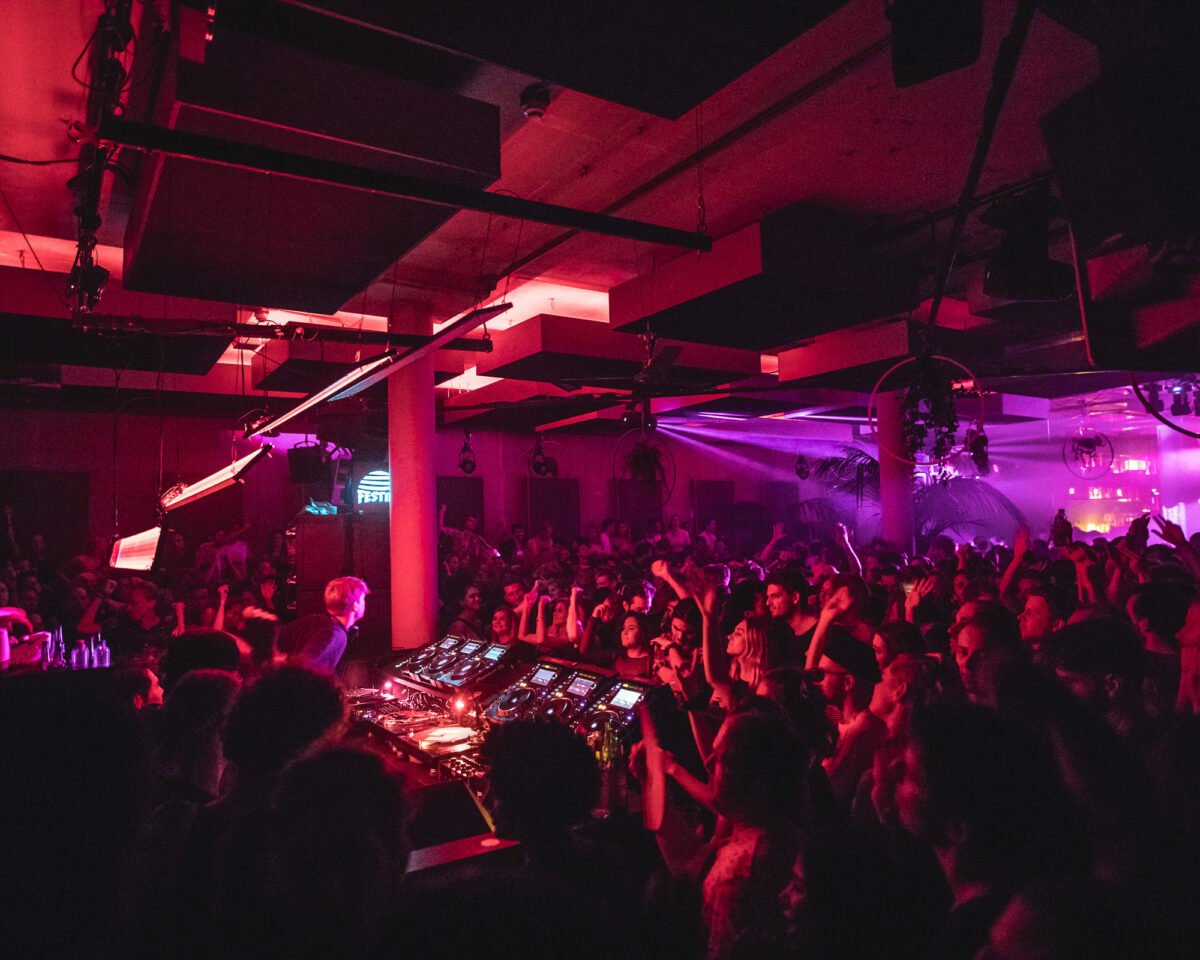
The physical transition into Shelter is an important part of the experience. Visitors enter near the base of A’DAM Tower and descend below ground level, leaving behind the open waterfront and illuminated skyline. Inside, the architecture becomes deliberately restrained: concrete, dark surfaces, limited decoration and a relatively straightforward relationship between DJ booth and dancefloor.
Unlike clubs where industrial architecture is inherited from a building’s previous function, Shelter’s underground character was largely intentional. This distinguishes it from much of Amsterdam’s club history. Trouw occupied the former printing plant of a newspaper, De School transformed a technical school, while Garage Noord developed organically inside a former car workshop. Shelter instead attempted to construct the conditions of an underground electronic music club within a newly redeveloped cultural complex.
The club’s layout reflects that focus. Rather than functioning as a collection of restaurants, exhibition rooms, studios and cultural spaces, Shelter concentrates most of its identity around the dancefloor. The DJ booth sits close to the audience, avoiding the monumental stage arrangement common to festival-oriented venues, while lighting is designed to support the room rather than turn the artist into a visual spectacle.
Sound and Music
Sound has been fundamental to Shelter’s identity since its opening. The underground construction made it possible to develop the room around acoustic requirements instead of adapting an existing concert hall or warehouse. The system is designed to provide substantial low-frequency energy while retaining clarity across the dancefloor, with the relatively simple architecture keeping attention on the relationship between music, DJ and audience.
House and techno form the core of the programme, although Shelter has explored a broad spectrum within those traditions. Deep and minimal house, acid, electro, Detroit-influenced techno, hypnotic styles and harder contemporary forms of techno have all appeared regularly. International touring DJs are an important part of the calendar, making Shelter more closely connected with the global house and techno circuit than some of Amsterdam’s smaller community-oriented spaces.
At the same time, the club operates within a particularly rich local ecosystem. Amsterdam has a long tradition of DJs, producers, labels and record stores that move relatively freely between house, techno, electro, disco and more experimental forms of electronic music. Institutions such as Rush Hour helped establish a culture in which musical knowledge and record collecting remain important parts of DJ identity. Shelter’s programme is more dancefloor-focused than that of Doka or Garage Noord, but it remains connected to this wider Amsterdam tradition.
Extended Club Culture
An important element of Shelter’s original identity was its connection with Amsterdam’s experiment with 24-hour nightlife licences. The city became internationally recognised for giving selected cultural venues greater freedom over operating hours, allowing them to move beyond the conventional model in which every club must close at approximately the same point in the morning.
The policy became particularly associated with Amsterdam’s development of the night-mayor concept and attempts to treat nightlife as part of urban cultural policy rather than simply as an entertainment industry requiring regulation. Longer licences allowed clubs to experiment with extended events, daytime programming and parties whose duration could be determined by the programme rather than a rigid closing hour.
For Shelter, this flexibility fitted naturally with the underground club model. It did not mean that every event became a 24-hour marathon, but it provided greater freedom for longer sessions and special events. In this respect, Shelter became part of a wider European culture in which the duration of a party can significantly change the relationship between DJ and audience.
A Different Kind of Underground
Shelter occupies an unusual position within Amsterdam because it combines underground club culture with a major commercial redevelopment project. The contradiction is particularly visible when the venue is compared with Garage Noord. Both clubs are located in Amsterdam-Noord, but they represent two very different stages in the transformation of the district.
Garage Noord grew organically inside a former workshop and retains much of the improvised character associated with independent cultural spaces occupying old industrial Amsterdam. Shelter exists inside the new Noord: professionally redeveloped, architecturally controlled and integrated into one of the waterfront’s most prominent destinations. Nevertheless, the objective downstairs remains to create a self-contained environment in which the commercial activity and visibility of the building above become largely irrelevant.
This contrast reflects a wider transformation of Amsterdam-Noord. Historically separated from the city centre by the IJ and associated with shipbuilding, factories and working-class neighbourhoods, Noord has become one of Amsterdam’s most rapidly changing districts. The former NDSM shipyard developed into a major cultural area, new residential projects appeared along the waterfront and the opening of the Noord/Zuidlijn metro in 2018 further integrated the district with the rest of the city. Electronic music has become part of that transformation, occupying both surviving industrial spaces and newly constructed cultural infrastructure.
Amsterdam Dance Event
Shelter’s international character becomes particularly visible during Amsterdam Dance Event. Every October, the city becomes one of the global centres of electronic music, with clubs, concert halls and temporary venues hosting hundreds of events connected with labels, artists and promoters from around the world.
Shelter’s combination of a focused dancefloor, international programming and central accessibility makes it a natural ADE venue. Label showcases and extended club programmes connect the space with the wider international house and techno circuit, while its location creates one of the more distinctive approaches to a nightclub in the city: leaving Amsterdam Centraal, crossing the IJ by ferry and descending underneath a former Shell office tower.
The relationship with ADE also illustrates Shelter’s position between local club and international destination. It is not primarily an experimental community venue like Garage Noord, but neither does it operate on the scale of a major concert hall. Its relatively concentrated format allows established international artists to perform in an environment that still functions as a club rather than a large event space.
Dancefloor Culture
Shelter has traditionally emphasised the atmosphere of the dancefloor and the idea that visitors should understand the character of the event they are attending. Like many Amsterdam venues, it promotes policies concerning consent, respect and inclusivity and rejects racism, sexism, homophobia, transphobia and harassment.
These principles have become increasingly explicit across European club culture. The freedom traditionally associated with nightlife depends on creating an environment in which different groups can participate without being threatened or harassed. For clubs, this means that door policy, security and audience behaviour become part of the design of the experience rather than simply operational issues.
Shelter’s relatively minimal interior supports the same philosophy in another way. The absence of a monumental stage and the close relationship between booth and audience reduce the distinction between performer and crowd. The DJ remains important, but the room is organised around collective dancing rather than the visual consumption of a performer.
Shelter and De School
Shelter’s position within Amsterdam became particularly interesting in comparison with De School. Both venues opened in 2016, but their philosophies were significantly different. De School occupied a former technical school in Amsterdam-West and developed into a multidisciplinary cultural institution containing a club, restaurant, café, exhibition spaces and other programmes. Its identity was strongly connected with the building, its local community and the knowledge that the project itself was temporary.
Shelter was considerably more concentrated. It was primarily designed as a nightclub, allowing the organisation to focus on a relatively traditional set of elements: DJ, sound system, lighting and dancefloor. Where De School could feel like an entire cultural world containing a nightclub somewhere inside it, Shelter offered a more direct interpretation of the European underground club model.
The closure of De School in January 2024 changed Amsterdam’s nightlife landscape considerably. It removed one of the city’s most internationally recognised institutions and again demonstrated the temporary nature of many important Amsterdam clubs. Shelter, meanwhile, continued operating beneath A’DAM Tower, becoming one of the established venues capable of regularly presenting international house and techno artists in a dedicated club environment.
Present
Today, Shelter remains beneath A’DAM Tower at Overhoeksplein 3 and continues to occupy a distinctive place within Amsterdam’s electronic music ecosystem. Its identity is more straightforward than that of many of the city’s culturally hybrid venues: it is fundamentally built around electronic music and the dancefloor.
Within a broader map of Amsterdam nightlife, each venue represents a different model. Paradiso demonstrates how the counterculture of the late 1960s could evolve into a permanent cultural institution. Doka combines intimate clubbing with listening culture inside the basement of a former newspaper building. Garage Noord represents the experimental, community-oriented possibilities of Amsterdam’s remaining industrial spaces. Trouw and De School, meanwhile, demonstrated how temporary architecture could produce club institutions with an international influence far beyond their limited lifespan.
Shelter represents another path: a modern nightclub deliberately constructed for electronic music within the redevelopment of Amsterdam-Noord. Above ground stands a renovated corporate tower, surrounded by new cultural institutions, restaurants, offices and residential development. Beneath it is a dark, purpose-built room where architecture is deliberately reduced to the elements required for sound and dancing. That contrast between the rapidly changing city above and the controlled anonymity of the dancefloor below remains one of Shelter’s most distinctive characteristics.
