



60 Dock Rd – London E16 1YZ, United Kingdom
The Cause is one of the most important independent club projects to emerge from London during the last decade. Originally opened in Tottenham in 2018 as a temporary grassroots venue, it developed into a much larger cultural project built around underground electronic music, DIY spaces, independent promoters and community.
Unlike clubs defined primarily by a single room or musical genre, The Cause has always operated more like an evolving nightlife ecosystem. Multiple dancefloors, hidden rooms, courtyards, bars and temporary structures allow very different parties to exist within the same complex, while its programming moves between house, techno, disco, UK bass, garage, jungle and more experimental forms of electronic music.
Its history is also closely connected with the changing geography of London nightlife. The Cause has repeatedly occupied spaces threatened by redevelopment, turning temporary industrial sites into cultural venues before being forced to move again.
Origins in Tottenham
The Cause was founded by Stuart Glen and Eugene Wild and opened in April 2018 on Ashley Road in Tottenham Hale, North London.
The original project was intended to last for only around eighteen months.
Its home was an industrial warehouse inside an area undergoing major redevelopment. Rather than waiting for the buildings to disappear, the team transformed the site into an independent club using a largely DIY approach.
The Cause was created partly as a reaction to the continuing disappearance of London’s grassroots nightlife. During the preceding decade, numerous clubs had closed because of redevelopment, licensing pressures and rising property values. The project therefore placed independence and community at the centre of its identity.
From the beginning, it also had a charitable dimension. The founders pledged to raise money for mental-health organisations, particularly causes connected with the electronic music community. What began as a temporary fundraising project gradually became something considerably larger.
The club was built with the help of friends, artists, promoters and volunteers. Its relatively rough architecture was not disguised: exposed industrial materials, improvised structures and dark rooms became part of the aesthetic.
The main dancefloor was built around a custom Core sound system, while smaller rooms allowed different promoters and musical communities to operate simultaneously.
From Temporary Club to London Institution
The eighteen-month plan quickly disappeared.
The Cause attracted a strong audience and developed relationships with a wide range of independent promoters, labels and collectives. Instead of closing after its planned lifespan, the club continued operating in Tottenham for several years.
Its musical identity remained deliberately broad.
Techno and house formed important parts of the programme, but nights could also include disco, electro, acid, drum & bass, jungle, UK garage, dub and various forms of experimental dance music.
This distinguished The Cause from clubs built around a clearly defined genre identity.
The project was less interested in establishing a recognisable “Cause sound” than in providing infrastructure for different parts of London’s underground scene.
The physical site also continued to evolve.
New rooms, bars and outdoor areas appeared over time, giving the venue the feeling of a small self-contained nightlife district rather than a conventional nightclub. Some spaces could hold large crowds, while others felt closer to informal afterparty rooms.
This process of continuous construction became part of The Cause philosophy: spaces did not necessarily need to look finished in order to function culturally.
The Covid Period
Like the rest of British nightlife, The Cause was forced to close its dancefloors during the Covid-19 pandemic.
For an independent venue operating on a temporary site, the interruption represented an existential threat.
The team responded by adapting parts of the site to changing government restrictions, using outdoor areas and developing different event formats whenever regulations allowed.
The pandemic also extended the strange lifespan of the Tottenham venue. A club originally expected to disappear in 2019 remained part of London nightlife several years later.
When restrictions were eventually removed, The Cause returned with an extensive programme of events and a series of farewell parties.
By then, redevelopment of the surrounding area could no longer be postponed.
Goodbye Tottenham
The original Cause closed at the beginning of 2022.
Its final programme turned the closure into an extended celebration of the community that had developed around the venue since 2018.
The end of Tottenham did not, however, mean the end of The Cause.
By this point, the project had developed an identity independent of its original building. The team began operating more nomadically, producing parties in different spaces while searching for a new permanent base.
One of the most important temporary chapters was The Cause at 60 Dock Road, while the organisation also became involved with other venues and projects across London.
The period demonstrated that The Cause had evolved from a nightclub into a promoter and cultural organisation capable of creating spaces in very different environments.
East London
The next major chapter brought The Cause to East London.
In 2024, the team opened a new permanent-scale complex at 60 Dock Road, close to Canning Town and the Royal Docks.
The move reflected a wider migration of London nightlife.
For decades, clubs and warehouse parties have followed the availability of industrial property across the city. As areas such as Shoreditch and Hackney became increasingly expensive and residential, electronic music culture moved further east towards Stratford, Canning Town, Silvertown and the Royal Docks.
The Cause followed exactly this trajectory.
Its new environment consists of former industrial and commercial buildings surrounded by railway infrastructure, warehouses and large redevelopment zones — a landscape considerably removed from the polished nightlife districts of central London.
This industrial isolation also provides something increasingly valuable for club culture: space.
60 Dock Road
The current Cause is considerably more complex than the original Tottenham club.
Instead of attempting to reproduce the old venue room by room, the team developed another evolving collection of spaces within the new site.
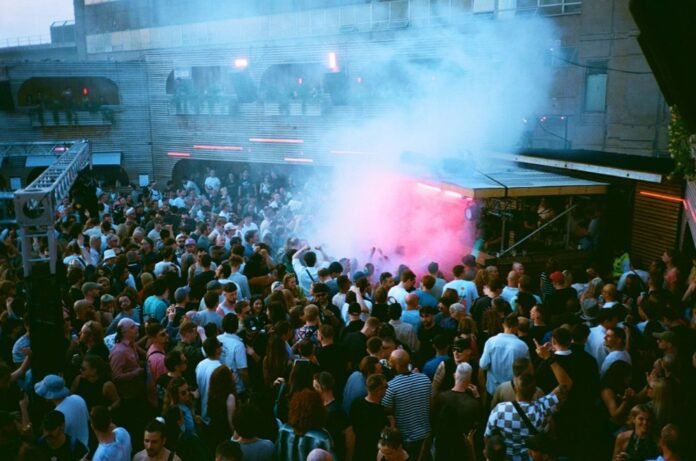
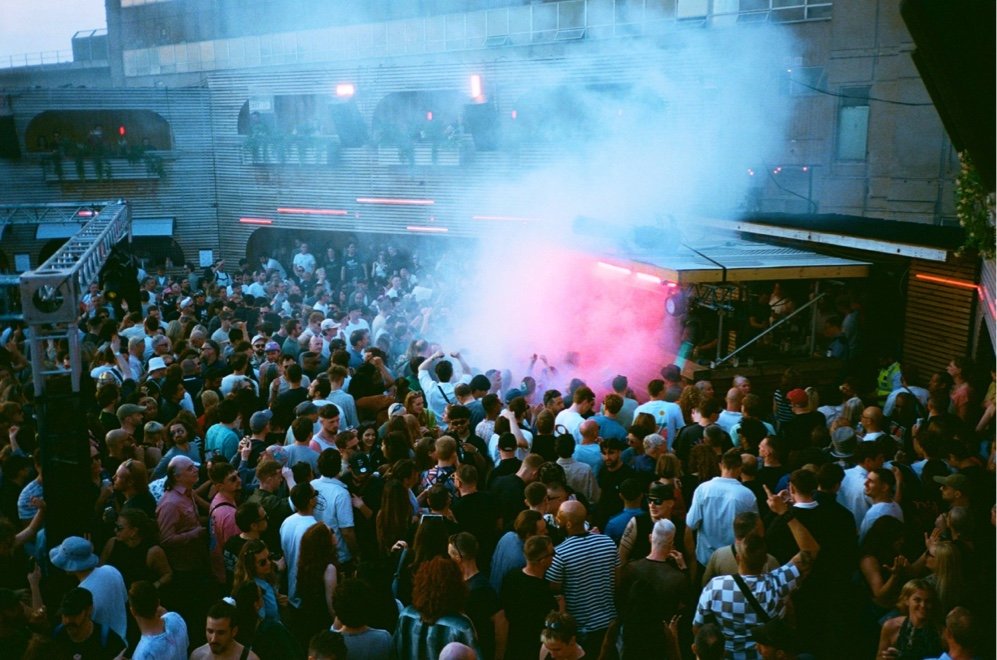
Multiple indoor rooms coexist with outdoor areas, bars, food spaces and smaller environments hidden throughout the complex. Different parts of the venue can be opened or closed depending on the scale and character of an event.
This modular architecture allows The Cause to function in several ways.
On some nights it operates as a relatively focused club. During larger events, however, the entire complex can become a miniature festival, with different promoters and musical styles occupying separate spaces simultaneously.
The design remains deliberately raw.
Industrial materials, exposed structures, improvised details and reused objects preserve the DIY character of Tottenham. The objective is not to create the visual perfection of a newly constructed nightclub but to allow the space to evolve through use.
That imperfection is part of The Cause identity.
Music and Independent Promoters
Musically, The Cause remains one of London’s most eclectic major underground venues.
House and techno are fundamental, but the programme regularly extends into disco, electro, breaks, UK garage, jungle, drum & bass, dub, trance and harder forms of club music.
This breadth reflects the structure of the project itself.
Rather than programming everything exclusively in-house, The Cause works extensively with independent promoters and collectives. Individual rooms can therefore develop completely different identities during the same event.
A techno set in one space might coexist with disco in another and jungle somewhere else.
The model reflects London’s electronic music culture particularly well. Unlike cities where one dominant sound can become closely associated with a particular club, London has historically developed through overlapping scenes: acid house, hardcore, jungle, drum & bass, garage, dubstep, grime, house and techno have repeatedly occupied the same city while maintaining their own communities.
The Cause provides physical infrastructure for this diversity.
Community and Fundraising
Community has been central to the project since its creation.
The original Tottenham club was partly established as a fundraising initiative for mental-health charities. Over its first years, The Cause raised significant amounts for organisations including Mind in Haringey, CALM and Help Musicians.
This charitable origin helped shape the wider philosophy of the venue.
The Cause presents nightlife not simply as entertainment but as a social ecosystem involving artists, promoters, technicians, bar staff, independent businesses and audiences.
Its approach is also explicitly inclusive. The venue maintains policies against racism, sexism, homophobia, transphobia and harassment and works with promoters representing different communities within London’s nightlife.
Like FOLD, this places The Cause within a generation of clubs that increasingly treat the social conditions of the dancefloor as part of club design rather than simply a security issue.
The Cause and London’s Temporary Spaces
Perhaps the most interesting aspect of The Cause is its relationship with temporary urban space.
The original Tottenham club existed because a building was waiting for redevelopment. Its cultural value emerged precisely during the period between one economic use and another.
This model has a long history in electronic music.
Warehouses, factories and abandoned commercial buildings provide the large rooms and relative isolation that club culture needs, but their availability is often temporary. Once an area becomes desirable for housing or commercial development, the same cultural activity that helped make it attractive can be displaced.
The Cause experienced this directly in Tottenham.
Its move east therefore represents both survival and repetition. The Royal Docks and Canning Town are now undergoing many of the same regeneration processes that previously transformed other parts of London.
The question of permanence remains unresolved.
In this sense, The Cause is almost designed around impermanence. Instead of relying on a particular building, the organisation has learned how to construct a cultural environment wherever suitable space remains available.
Present
Today, The Cause at 60 Dock Road is one of London’s largest and most distinctive independent electronic music complexes.
Its programme combines regular club nights with extended daytime events, label showcases, takeovers and large multi-room parties. International artists appear alongside London DJs, emerging selectors and independent collectives.
The current venue is larger and more ambitious than the original Tottenham warehouse, but the fundamental principles remain recognizable: DIY construction, independent programming, multiple communities and a preference for spaces that feel discovered rather than designed as conventional entertainment venues.
This makes The Cause very different from both Phonox and FOLD.
Phonox reduces clubbing to one carefully controlled room. FOLD builds its identity around long-form techno, a 24-hour licence and the collective intensity of its dancefloor. The Cause operates almost like a small city of nightlife — chaotic, modular and constantly changing.
Its story also captures one of the central contradictions of contemporary London club culture.
The city continues to produce some of the world’s most influential electronic music communities, yet the physical spaces supporting those communities are increasingly difficult to maintain.
The Cause has survived by accepting that instability as part of its identity.
What began as an eighteen-month experiment in a condemned Tottenham warehouse has developed into a long-running cultural project capable of rebuilding itself in another part of the city. The buildings may remain temporary, but The Cause itself has proved considerably more permanent.
