





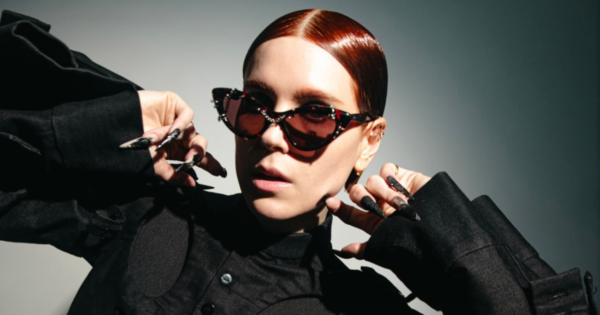
We find her sound somewhere between the darkest and grittiest corners of techno, in dodgy backrooms, abandoned warehouses and illegal parties. Meet NLI – the London-based producer, DJ & owner of Adhesive Records – and a sincere voice in modern electronic dance music. „I was told ‘no’ for years before I actually got somewhere in music”, says NLI openly, and despite many doors closed, her courage and resistance to rejection took her into places or events she always dreamed of.
Teletech, Junction 2, E1 or M.O.T. in London, as well as debut in Berlin’s Tresor or Alte Münze. NLI’s story is a prominent example of following one’s heart – truly, madly, deeply – as well as sharing this vision with the audience.
Agata Omelańska: Hello Nellie, welcome to Underton! Let’s start with a simple one: how is your life going? Where have you been recently, how did you spend the summer festival season and what are you currently focused on?
NLI: Life is fantastic! Summer was very exciting, I had some really interesting gigs including Junction 2 in London and my debut at Tresor in Berlin. Been working on a lot of new music and have multiple releases lined up. I’ve also taken a lot of time to reflect on the past year in the studio by exploring new directions within my sound. It has resulted in some pretty good tracks actually – very excited for these to be out over the coming months!
Our main topic of the interview is your brand new EP, „SUBCULTUR3”, which is coming out on 29th October. Music-wise, it oscillates around darker techno, psy-tech, acid or industrial elements. If you could describe this material in one word, which one suits it best and why?
Subculture – the title plays upon that wor(l)d. It explores the darkest and grittiest corners of my sound.
And if perceived in a bigger picture, what does this EP mean to you? What kind of emotions or reflections you wanted to share with your audience?
These tracks take the listener on a journey that ventures into the world I was a part of in the early stages of my career. The vibe is very much dodgy backrooms, abandoned warehouses and illegal parties kinda vibe. It’s fun but also grim.
The story behind these 3 tracks is quite a wide concept: it touches a lot of sensitive topics of the music industry, but it still holds a darkly satirical manner. How did you come up with this idea? And how did you translate it into the language of music?
You know how the industry pressures everyone to keep their mouth shut on all the important things – I’d say at the minute things are worse than ever, yet everyone is too scared to get to the point and say it as it is. At the same time, it’s really comical how everyone is talking about these issues (but only behind closed doors) – yet when it truly matters, people suddenly just go: ‘Not my circus, not my monkeys’.
And was it easy for you to break some kind of industry taboos? What are the biggest and most uncomfortable truths that producers – women especially – have to face in their everyday work?
I think many emerging artists underestimate how clique-y the industry really is. Everytime someone new comes to the scene, you take them seriously up until you witness their talent in real life (or lack thereof) – or uncover who helped them get to wherever they are currently. While this is nothing really new or exclusive to techno, I think this is the main reason why a lot of female producers need to move mountains and do the impossible to get anywhere at all.
I’ve in the past had to break down doors that didn’t open for me – and if that failed, I’ve had to just build my own doors. It’s hard work, believe me.
In your opinion, what’s the biggest obsession of the electronic music industry right now? What – instead of music – became the new idol (or the golden calf) and how do artists cope with it?
Proving that you’re doing it ‘for the music’ – the more desperately you’re trying to prove yourself, the less convincing it becomes. The scene is full of pick me’s at the moment.
Your music is really hard to categorize, as you don’t put yourself into one particular genre and you follow your vision first, not the people’s expectations. How is „SUBCULTUR3 EP” connected to your previous releases? Or maybe it’s not connected at all and it opens some new chapters for you?
All my releases are part of the same universe. It builds upon the existing foundation of Initiation and Siren especially, it continues to explore the lessons I learned in the early stages of my career, my time in the underground and the period of my life where I learned to navigate the difficulties of the industry. All the important lessons I learned along the way are the flesh and blood of SUBCULTUR3 – I really do hope that this EP gives hope to someone who is struggling with standing their own ground in a world that tells them their vision isn’t what it ‘should be’.
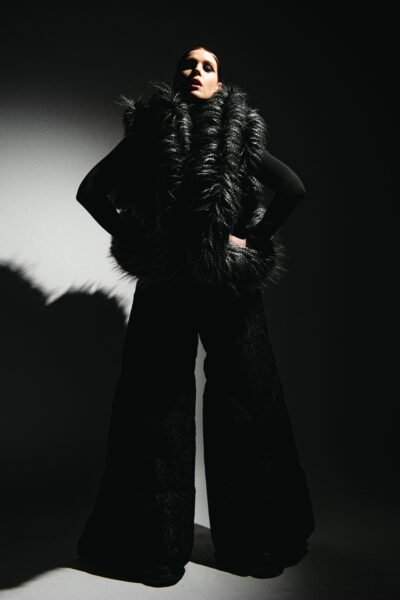
Speaking of your artistic activity, I cannot omit Adhesive Records – the label you launched not only for your own releases, but also for other artists. What is your mission and how do you want to be perceived by the electronic music industry?
I think someone once referred to me as a troublemaker and I’m here for it.
I think all Adhesive artists share this sentiment with me – we all want to disrupt, subvert and challenge the industry. We’re not going to sit down and do as we’re told because, I hate to say it, know better. We’re actual musicians, we don’t just pretend to be, you know.
And the other important milestone is, undoubtedly, your debut in Berlin’s Tresor, in August 2026 – how was it? What does it mean to you to play your music in the most iconic European techno clubs? What was the element of that night that you’ll remember forever?
It was incredible – I actually thought about it while sitting in my car earlier today. It was such a magical weekend and it was perfect in every way! The crowd was incredible, very open and very receptive to all my crazy music! I love Berlin whole heartedly and it was such a treat to be able to perform at an institution like Tresor. When I entered the club, it felt like I was stepping onto holy ground.
One of the most interesting facts about you is that before entering the world of electronic music, you were a concert pianist. You’ve experienced years of professional training and although you changed the instrument, your experience and knowledge matter. I wonder if there are any methods from your classical period that are still helpful today? Or the door – once closed – is no longer needed on your current path?
I will always carry the lessons I learned in the classical world with me – piano is my musical foundation and it will always be a core part of my identity as a musician. It shaped me into the musician I am today. Those roots run very deep – you can take a girl out of the classical world, but you can never take the classical world out of a girl. I will never not cringe when something is out of tune.
I’m highly impressed by the stories behind your music and the emotional aspect of it. Speaking of inspiration, you often mention science, technology, philosophy or dystopian fiction – what a rich world to draw from! How do you work with inspiration and how it is finalized with a track?
It always falls back upon my interpretation of it. I constantly explore new ways of communicating this world through sound. It’s an interesting process – each track sounds really scary in its early stages, I usually start out with chords or some ambient noise, which I then layer to package into a final piece. You could easily make a whole dystopian horror film score out of it.
Your approach to AI is also an interesting point of view – while many criticize it and consider it a negative tool, you seem to be more enthusiastic about it. How can AI help in terms of music production or what kind of problems it can solve?
I think AI is great for streamlining your workflow and helping your organising process. As I’m sure you know, I’m not particularly in favour of using AI to make music – I think it’s very obvious when AI has been used for this purpose and to be honest, it doesn’t sound that good. It’s like, you can hear that it works but something about it is off – in a really bad way. I personally wouldn’t do it but each to their own, I guess.
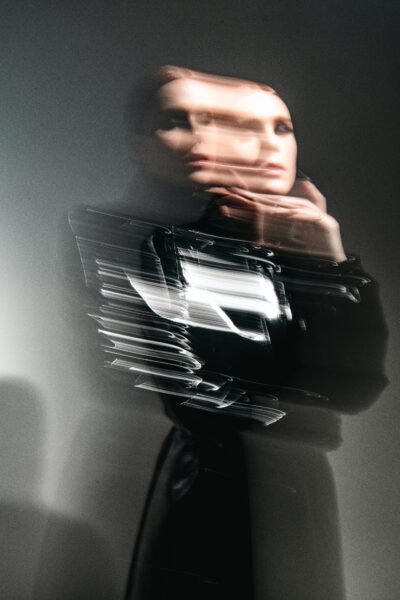
You’re based in London, one of the most important cities for electronic music in the world. How did you find your sound and style there? What shaped you as an artist, what was your biggest challenge to face and what – on the contrary – was the most pleasant experience so far?
I started out in the underground world and have taken a lot of inspiration from there (I still do!) and think that the people who challenge underground culture, come up with new ideas, concepts and ways of thinking are extraordinary. Meeting people like that has been one of the experiences I treasure the most. I’ve met some of the best people in the underground, but the same goes for the opposite – when you encounter bad people in that sphere, it really is the worst of the worst. The problem is there’s quite a few of them and they don’t care about preserving underground culture or techno, they just want to be famous. It’s unfortunate.
When you leave the studio for the club (when you’re not playing), how do you like to experience the nightlife? What kind of raver are you and what inspires you the most in the underground?
I love going to raves and really miss my proper rave days! As we all know, raves now unfortunately become a ‘who is who’ kind of occasion,
which means it’s very difficult going to one where there’s no photoshoot or content shoot going on (which I find very disruptive) and it’s become a gossip echo chamber.
When I do go to raves, I try to make it as anonymous of an experience as possible – I show up in sunglasses and a hood (because my hair tends to give me away quite quickly, haha) to be able to get lost in the moment and immerse myself in the sonic world that the artist is building for everyone that night.
What’s your superpower? Not only in music, but in all other aspects of life?
I think my resilience is probably my superpower – I was told ‘no’ for years before I actually got somewhere in music. Being excluded and rejected because I didn’t have the right friends or connections can be really tough, because it makes you feel isolated to the point where you would probably start questioning your own worth. I kind of just pushed through it and never doubted myself and my talent – I’ve always been like that as a person and think it’s served me well!
Thanks a lot for the interview, Nellie! It was a pleasure to meet you and see the world of electronic music through your eyes!
Thank you very much for having me and for the great questions!